
How to Start AI Literacy Programs at Work
NWA AI Team
Editor

How to Start AI Literacy Programs at Work
AI is changing how we work, making tasks faster and decisions smarter. But without proper training, businesses risk falling behind, misusing tools, or facing ethical and legal issues. Building AI literacy across all roles - not just IT - helps teams work efficiently, identify new opportunities, and use AI responsibly.
Here’s how to get started:
- Assess your readiness: Review current AI tools, their impact, and risks. Identify skill gaps using surveys or interviews.
- Set clear goals: Use the SMART framework for measurable outcomes, like improving AI knowledge by 30% or training specific teams within a set timeline.
- Design tailored training: Offer role-specific learning paths. For instance, executives focus on strategy, while general staff learn practical AI applications like creating prompts or analyzing data.
- Start small, then expand: Test with a pilot group, refine the program, and roll out in phases across departments.
- Measure progress: Track knowledge improvements, tool adoption rates, and productivity boosts. Adjust the program based on feedback and results.
- Keep learning alive: Regularly update content, host workshops, and encourage employees to share their AI successes.
Investing in AI literacy helps businesses stay competitive while empowering employees with essential skills for today’s job market. Start small, track results, and build a culture of learning.
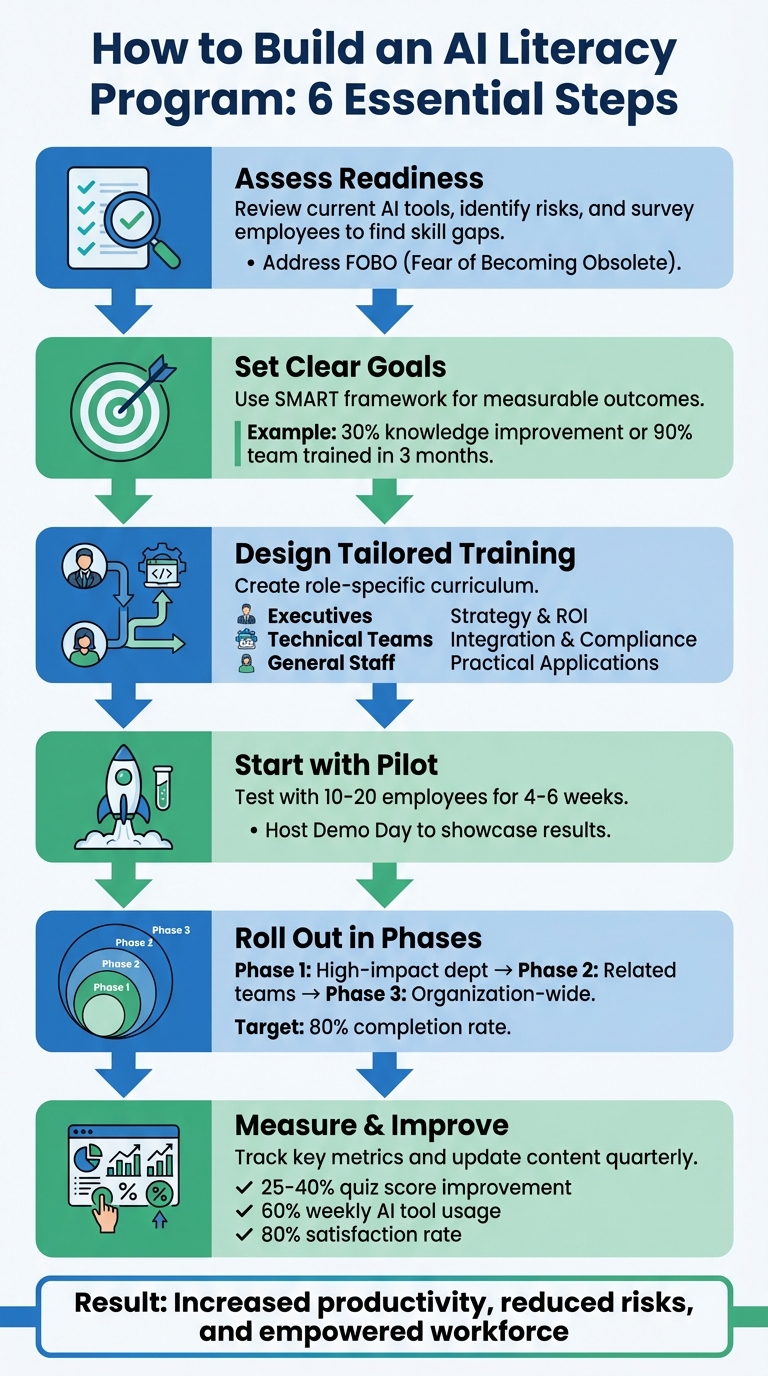
6-Step Framework for Implementing AI Literacy Programs at Work
How to build AI literacy into your organizational DNA
Assess Your Organization's Readiness and Set Clear Goals
Start by taking stock of your organization's AI landscape. Document the systems you currently have in place, evaluate their business impacts, and identify any associated risks. This process helps establish a baseline that highlights where your teams might lack skills. By doing this, you not only reduce risks tied to AI deployment but also align your efforts with broader AI literacy objectives.
Identify Skill Gaps
Pinpointing skill gaps requires direct engagement with your employees. Use tools like surveys, one-on-one interviews, focus groups, and all-hands meetings to gauge their understanding of AI concepts and tools. Ask practical, straightforward questions: Do they know what AI can and cannot do? Can they create effective prompts? Are they aware of ethical concerns like bias or data protection? Incorporate a mix of rating scales and open-ended questions to get a well-rounded picture of their abilities.
It's also essential to address emotional concerns, such as the fear of job loss, often referred to as "fear of becoming obsolete" (FOBO). Infosys tackled this challenge with its Springboard platform, which focuses on aligning AI training with career growth rather than replacement. Openly acknowledging these worries can build trust and encourage employees to engage in training.
KPMG offers a useful example of how to turn these insights into action. After discovering gaps in AI terminology, ethics, and prompting skills, they introduced a generative AI training program that required mandatory participation. This ensured their teams were well-equipped for responsible AI use.
Set Measurable Goals
Once you've identified the gaps, translate them into clear, measurable goals. The SMART framework - specific, measurable, achievable, relevant, and time-bound - can guide this process. For instance, you might set a goal like: "Train 90% of the sales team on AI prompting within three months, with pre- and post-training quizzes showing a 30% improvement in knowledge to enhance lead analysis efficiency."
Your goals should also account for varying competency levels across your organization. Executives may need training in strategic AI decision-making and ROI measurement, while everyday users might focus on practical skills with no-code tools and ethical guidelines. Track progress using metrics such as course completion rates, quiz scores, AI tool usage frequency, productivity improvements, and participant feedback. As Hamsa Suresh highlights, high adoption rates in daily workflows are a strong indicator of genuine confidence, not just box-checking. Leadership plays a key role here by embedding AI literacy into performance reviews and championing continuous learning. Kraft Heinz, for example, demonstrated this through their 24-hour global AI learning day initiative.
Design Your AI Literacy Program
With clear goals in mind and gaps identified, the next step is to craft an AI literacy program that directly addresses your business needs. The best programs start with a shared foundation for everyone and then branch into role-specific tracks tailored to how different teams use AI in their daily work. This personalized approach encourages hands-on learning and collaboration.
Create Role-Specific Curriculum
The key to an effective program is tailoring content for each role. Start with a straightforward overview of AI concepts, complete with practical examples and guidance on its capabilities, limitations, and ethical use. This foundation should also include privacy, security, and ethical considerations, along with your company’s AI policies. This ensures everyone knows which tools and use cases are approved.
From there, adapt the content to fit the way each role interacts with AI. For instance:
- Executives need training on AI strategy, risk management, and ROI, often through case studies.
- Technical teams benefit from deeper dives into topics like model selection, evaluation, integration patterns, and compliance.
- General staff can focus on practical applications like drafting emails, summarizing documents, analyzing data, and conducting research. Emphasize skills like crafting effective prompts and critically evaluating AI outputs.
Create tiered learning pathways such as "Essential AI for Everyone", "AI for People Leaders", and "AI for Builders", aligning each with specific skills. Map out the typical tasks and decisions for each role, then connect these to real-world AI use cases to make the training immediately relevant.
Include Hands-On Training
While theory is important, practice is what truly solidifies learning. Employees need opportunities to use AI tools in guided, low-pressure environments that mimic real workplace scenarios. Start with no-code or low-code AI tools so non-technical staff can focus on using AI in their workflows rather than worrying about programming. Practical exercises might include tasks like rewriting customer emails, summarizing reports, building basic automations with AI-enabled tools, or using AI-powered search and analytics to answer business questions.
Design labs around real U.S. workplace scenarios - such as customer support, marketing, financial analysis, or HR - while adhering to strict data privacy guidelines. Facilitators can demonstrate effective prompting techniques, then guide participants as they refine their prompts and evaluate outputs. This helps reinforce what works, what doesn’t, and how to apply these lessons on the job.
Interactive methods like workshops, live demos, case studies, and risk simulations boost confidence and adoption. For example, exercises where participants spot errors in AI-generated content - like hallucinations, bias, or policy violations - help build practical judgment. Decision-making simulations, where leaders choose between AI options with varying risks and benefits, are especially valuable for teams working on high-stakes applications. To speed up learning, consider bringing in experienced professionals to guide the process.
Partner with External Experts
Building an AI literacy program from scratch can be time-consuming. External partners can ease the process by offering proven curricula, experienced facilitators, and implementation guides to help you get started faster. For example, NWA AI – Northwest Arkansas AI Innovation Hub offers no-code AI training designed for U.S. workplaces, aligning with industry needs and regulations. They can assess skill levels, recommend learning paths from beginner to advanced, and train internal "AI champions" to sustain the program long-term.
When choosing a partner, prioritize those with experience working with organizations of similar size and U.S.-based teams. Look for a focus on practical tools and workflows rather than abstract theory, as well as the ability to integrate with your existing learning systems and policies. A strong partner can help you design role-specific tracks, lead workshops, and mentor your teams, enabling them to quickly transition from basic understanding to practical application - enhancing both performance and innovation.
sbb-itb-e5dd83f
Launch and Scale Your Program
To stay ahead in an increasingly competitive landscape, it's important to scale your program thoughtfully while encouraging a culture of learning. Test your ideas in real-world scenarios, gather feedback, and expand step by step. Jumping into a full rollout without proper validation can lead to wasted time, money, and low engagement.
Start with a Pilot Program
Begin by selecting a small, diverse group of 10–20 employees from various departments - think marketing, analytics, or sales - to participate in a 4–6 week pilot program. This group should include individuals with different levels of experience who are eager to learn and can advocate for the program within the company. The pilot should cover AI fundamentals and practical tools, such as ChatGPT or other no-code platforms, to ensure a solid foundation.
Create a supportive environment where participants feel comfortable asking questions and experimenting. Use condensed versions of your curriculum to test whether the material is both practical and engaging. Wrap up the pilot with a Demo Day, where participants showcase their AI projects. This not only validates their learning but also provides leadership with tangible examples of success, helping to fine-tune your broader rollout strategy.
Roll Out in Phases
Using feedback from the pilot, refine your curriculum and prepare for a phased rollout. Start with Phase 1, focusing on a department with high potential for quick wins, like sales or customer support. Move to Phase 2, expanding to teams with overlapping workflows or tools, such as marketing and communications. Finally, Phase 3 brings the program to the entire organization, with updates and adjustments at each stage.
Keep everyone informed through town halls, newsletters, and leadership workshops. To maintain momentum, set up a dedicated helpdesk or communication channel for support. Pair experienced participants from earlier phases with new learners through mentorship programs to encourage adoption. Track metrics like completion rates (aiming for 80% or higher), pre- and post-training assessments showing 20–30% knowledge improvement, and AI tool usage to measure progress and make adjustments as needed. This phased approach ensures a smooth rollout and sets the stage for ongoing training efforts.
Build a Culture of Continuous Learning
AI training shouldn’t stop after the initial rollout. To keep the momentum going, host quarterly workshops that dive into advanced AI tools and techniques. Use the role-specific training paths you’ve already developed to support deeper learning. Identify AI champions or ambassadors from your pilot program - these high-performing individuals can lead peer training sessions, share best practices, and provide feedback to leadership. Their involvement ensures AI remains a priority across the organization.
Establish a central learning hub with resources like videos, white papers, and tool guides so employees can continue learning at their own pace. Organize "pitch days" where employees present new AI use cases to spark innovation and collaboration between departments. Encourage senior leaders to participate in workshops and share their own AI experiments to show that continuous learning is a company-wide effort. By embedding AI into the fabric of your organization, you’ll create a culture of ongoing engagement and innovation.
For businesses in Northwest Arkansas, collaborating with local organizations like NWA AI – Northwest Arkansas AI Innovation Hub can enhance your efforts. They offer tailored training programs, hands-on workshops, and expert guidance to help you take your AI initiatives to the next level.
Measure Results and Make Improvements
Tracking the right metrics is essential to fine-tune your AI literacy program and ensure it delivers lasting results. Once your program is up and running, start by evaluating participant learning through pre- and post-training knowledge assessments. For example, Google's AI literacy pilots showed an impressive improvement in quiz scores - ranging from 25–40% - offering leadership clear evidence of the training's effectiveness. Set a goal for at least an 80% pass rate on post-training certifications to maintain a high standard.
Beyond knowledge, measure how the training translates into real-world productivity. Use time-tracking tools to evaluate time saved on repetitive tasks. In one case, Deloitte highlighted a financial services firm that achieved a 22% productivity boost after AI training, with analysts automating 40% of routine reports using tools like Copilot. Similarly, PwC observed 18% time savings in their marketing teams post-training. Compare data before and after training on metrics like the number of reports generated weekly or tasks completed daily to quantify the program's impact.
Employee feedback is equally important. Conduct quarterly anonymous surveys using tools like SurveyMonkey to measure confidence levels and gather actionable insights. Accenture’s AI programs, for instance, achieved an 85% satisfaction rate by incorporating employee feedback to create role-specific modules. Aim for an 80% response rate and a Net Promoter Score (NPS) of 70 or higher. Sentiment analysis tools like MonkeyLearn can help identify recurring themes, allowing you to tweak the curriculum based on actual employee needs.
Track Key Metrics
In addition to feedback, usage data offers valuable insight into the program’s success. Monitor AI tool adoption rates to see if employees are applying what they’ve learned. A benchmark of 60% weekly usage is a strong indicator of sustained engagement. Track metrics like error reduction (targeting 10–15%) and the number of new AI-driven projects initiated. Dashboards in tools like Tableau can help link training completion to key performance outcomes. For example, Microsoft’s internal AI training program was tied to a 12% revenue growth, making the case for ongoing investment in upskilling. These metrics not only validate the program’s effectiveness but also highlight areas for further improvement.
Update Content Regularly
Keeping your curriculum up-to-date is critical in a fast-evolving field like AI. Plan quarterly reviews and make immediate updates for major developments, such as the release of GPT-5. Allocate 10–20% of your program budget to ensure content remains relevant. Stay informed through sources like arXiv and AI newsletters, and consider adding 30-minute micro-modules to cover new features or techniques. Test these updates with a small beta group before rolling them out across the organization.
Annual skills audits can also help identify emerging gaps. Tools like Gartner’s AI maturity assessments can pinpoint areas needing attention - if, for instance, 40% of employees struggle with prompt engineering, consider adding a dedicated module. Salesforce addressed this exact issue and saw a 35% increase in adoption after updating their training. For companies in Northwest Arkansas, collaborating with organizations like NWA AI – Northwest Arkansas AI Innovation Hub can provide access to tailored training programs that reflect the latest developments in AI, even for employees without coding expertise. Regular updates like these help foster a culture of continuous learning and ensure your team stays ahead of the curve.
Conclusion
Start by identifying skill gaps, creating role-specific, hands-on training, and testing on a smaller scale before expanding. The goal? Cultivate a culture of continuous learning where AI complements human expertise rather than replacing it. Use key performance indicators to monitor progress, refine your approach, and highlight tangible business benefits like increased productivity, cost efficiency, reduced compliance risks, and faster innovation.
These programs don’t just improve workflows - they also boost employee morale and confidence. Workers gain skills that enhance their value in an AI-driven economy, while feeling less anxious about technology. They develop confidence in using AI tools responsibly. For instance, customer support teams can draft responses more quickly without sacrificing quality, sales teams speed up proposal creation, and operations teams make smarter decisions with AI-assisted insights. Over time, these everyday wins add up to major competitive edges.
Take the first step today - evaluate one department, plan an executive briefing, or kick off a small pilot program. Dedicate resources to ensure AI literacy becomes an ongoing priority. With the U.S. job market evolving rapidly, businesses that invest in workforce development now will be better prepared for future challenges.
To accelerate your efforts, consider partnering with experts like NWA AI – Northwest Arkansas AI Innovation Hub. Their three-stage framework - AI Literacy, AI Leverage, and AI Adoption - provides a straightforward path from foundational learning to measurable outcomes. Combining expert guidance with your internal initiatives ensures long-term success.
"AI tools have become integral to my daily work, streamlining processes and freeing up significant time for strategic contributions." – Pamela Johnston, Senior Business Analyst
Equip your team to work smarter with AI and gain a competitive edge - start today.
FAQs
How can we identify gaps in AI literacy within our team?
To pinpoint gaps in AI literacy, begin by gauging your team's grasp of AI fundamentals - this includes understanding what AI can and cannot do. You can use tools like surveys, interviews, or assessments to collect valuable insights. Then, evaluate practical skills by observing how employees interact with AI tools and incorporate them into their daily workflows. Lastly, examine their ability to design and implement strategies that leverage AI effectively.
Structured training programs can play a big role in bridging these gaps. Offering customized, hands-on learning experiences and fostering a supportive community can help your team grow their confidence and improve their ability to work with AI at all levels.
What are the best practices for creating role-specific AI training programs?
To create impactful AI training programs tailored to specific roles, start by pinpointing the distinct responsibilities and needs of each position. It's essential to build a solid foundation by helping employees grasp what AI can and cannot do, so they can spot areas where AI might improve their tasks.
Include practical, hands-on sessions with AI tools to ensure teams can apply their knowledge in real-world situations. The training should focus on practical workflows and aim for clear, measurable results. Foster an environment of continuous learning by offering ongoing support and highlighting the value of integrating AI into daily operations across the organization.
How can we evaluate the success of our AI literacy program?
To gauge how well your AI literacy program is performing, focus on outcomes that can be measured. Look for signs like a better grasp of AI concepts, greater confidence in using AI tools, and the adoption of AI in everyday workflows to save time and improve quality. Key metrics might include increased productivity, less time spent on routine tasks, and creative problem-solving within teams.
It’s also important to evaluate the program’s return on investment (ROI). This means tracking concrete results such as cost savings, efficiency improvements, and employee feedback about how AI has impacted their work. A strong program should not only enhance operations but also encourage a workplace culture that embraces progress and new ideas.
Build real AI capability on your work
The AI training programs are part of how Northwest Arkansas is approaching AI adoption.
Get involvedRelated Articles

ROI and KPIs in AI Process Optimization
Measure AI impact with ROI and KPIs: set baselines, track hard and soft ROI, and monitor model, system, and business KPIs to validate performance and value.

How Blended Learning Improves AI Upskilling
Blended learning, online modules plus hands-on workshops, boosts AI skill retention, engagement, and real-world application for faster workplace upskilling.

5 Steps to Define AI Workflow Goals
Set measurable AI workflow goals in five steps: map processes, set SMART targets, pinpoint AI opportunities, define KPIs, and align with strategy.