
How Blended Learning Improves AI Upskilling
NWA AI Team
Editor

How Blended Learning Improves AI Upskilling
Blended learning is a powerful way to teach AI skills by combining online modules with in-person sessions. This approach helps professionals balance work and education while gaining hands-on experience. AI is reshaping jobs, with 40% of skills shifting by 2025, making upskilling essential. Blended learning ensures learners not only understand AI concepts but also apply them effectively.
Key Highlights:
- What It Is: Blended learning alternates between online lessons and in-person workshops, offering flexibility and practical application.
- Why It Works: Studies show it increases engagement, retention, and skill application. Learners benefit from personalized AI tools and hands-on practice.
- Benefits: Higher participation rates (up to 40%), better skill retention, and improved outcomes compared to fully online or in-person methods.
- Implementation Steps: Assess skill gaps, design a hybrid curriculum, integrate local programs, embed learning into daily tasks, and measure results.
- Challenges Addressed: Overcoming digital literacy gaps, balancing formats, and ensuring accessibility.
Blended learning helps AI learners bridge the gap between theory and practice, making it an effective solution for today’s fast-changing workplaces.
How Does AI-Powered Blended Learning Rapidly Enhance Employee Upskilling?
Benefits of Blended Learning in AI Training
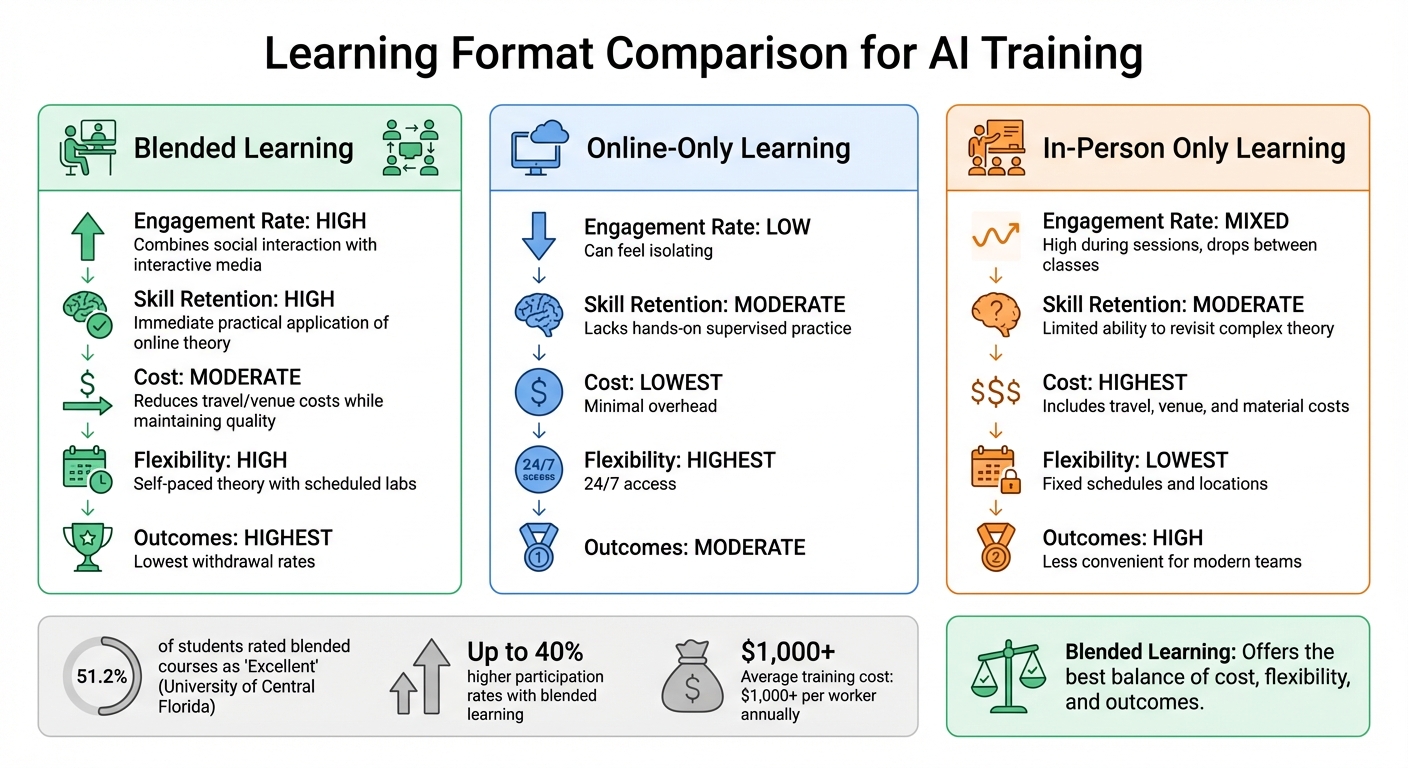
Blended Learning vs Online-Only vs In-Person AI Training Comparison
Better Engagement and Learning Results
Blended learning brings a dynamic mix of videos, simulations, and workshops to the table, making it easier for learners to grasp AI concepts and apply them to real-world scenarios. This approach keeps learners engaged and bridges the gap between theory and practice.
Take the University of Central Florida, for example. Their blended courses earned "Excellent" ratings from 51.2% of students, compared to 48.3% for fully online courses and 48.2% for traditional face-to-face classes. And it’s not just universities seeing these results - organizations that implement clear blended learning strategies report up to 40% higher participation rates compared to traditional training methods. By letting learners explore AI theory online at their own pace and then dive into hands-on workshops, this method helps them build confidence faster than either format could alone.
"The main idea behind blended learning lies in balance: digital tools build consistency and accessibility, while human interaction boosts understanding, motivation, and retention." - Alex Hey, Chief Marketing Officer, Coursebox AI
Blended learning programs that use personalized AI systems take things a step further. Research shows these adaptive platforms can significantly boost learning outcomes, with a large effect size (g = 0.88) - outperforming generic chatbots and standard tutoring systems. These tools track individual progress and adjust content to focus on the specific AI skills learners need, making the experience both targeted and effective.
This combination of engaging formats and personalized tools naturally leads to better retention and practical application of AI skills.
Improved Skill Retention and Practical Use
Blended learning doesn’t just engage learners - it helps them retain what they’ve learned. Without reinforcement, people forget up to 50% of new information within an hour, 70% in 24 hours, and 90% in a week. Blended learning tackles this issue by spreading AI concepts over time and providing multiple opportunities to practice.
Imagine watching a tutorial on prompt engineering at home and then attending a workshop the following week to build AI-powered workflows with instructor guidance. This theory-to-practice pipeline ensures learners aren’t just memorizing definitions - they’re applying knowledge in meaningful ways. Short-term AI-enhanced blended learning programs, lasting one week to one month, have shown a very large effect size of 1.14, highlighting their immediate impact on skill acquisition.
A real-world example comes from the University of Central Florida. Between 2002 and 2010, the university rolled out a large-scale blended learning initiative. By the 2009-2010 academic year, they offered 681 blended sections with 24,241 registrations. Students in these courses consistently achieved higher success rates (grades of C or better) and had lower withdrawal rates compared to those in purely face-to-face or online classes. The key? Opportunities to immediately test and apply what they learned in supervised environments.
Learning Format Comparison
A closer look at different learning formats highlights why blended learning stands out. Here’s how it compares to fully online and in-person-only approaches:
| Feature | Blended Learning | Online-Only Learning | In-Person Only Learning |
|---|---|---|---|
| Engagement Rate | High; combines social interaction with interactive media | Often low; can feel isolating | High during sessions, but drops between classes |
| Skill Retention | High; immediate practical application of online theory | Moderate; lacks hands-on supervised practice | Moderate; limited ability to revisit complex theory |
| Cost | High; reduces travel/venue costs while maintaining quality | Lowest; minimal overhead | Highest; includes travel, venue, and material costs |
| Flexibility | High; self-paced theory with scheduled labs | Highest; 24/7 access | Lowest; fixed schedules and locations |
| Outcomes | Highest; lowest withdrawal rates | Moderate | High, but less convenient for modern teams |
Blended learning strikes a balance between cost, flexibility, and outcomes. Digital modules cut down on travel, venue, and printing expenses, while live sessions maintain the personal interaction that builds confidence. Considering that companies already spend an average of over $1,000 per worker annually on training, adopting a blended approach ensures that investment delivers better results in both satisfaction and performance.
How to Implement a Blended AI Upskilling Program
Step 1: Identify Skill Gaps
Start by assessing your team's current skills. Use surveys and analytics to understand how AI tools are being used, gauge confidence levels, and uncover role-specific challenges. The numbers reveal a stark reality: 89% of executives recognize the need for better AI skills in their workforce, but only 6% have taken meaningful steps to upskill. Interestingly, employees are using generative AI tools three times more often than their leaders think, suggesting that informal expertise may already exist within your organization.
Create a skills matrix that links technical abilities, like prompt engineering and data modeling, with essential soft skills such as creative thinking and ethical decision-making. Tailor your assessment to different organizational levels - C-suite leaders need strategic vision, managers benefit from broader awareness, and frontline workers thrive with hands-on tool proficiency. Identify "early adopters" who are already experimenting with tools like ChatGPT or Copilot. These individuals can become peer mentors to help accelerate learning across teams. It's worth noting that 62% of C-suite leaders cite a lack of AI skills as the biggest hurdle to scaling AI initiatives.
"The central challenge of integrating AI in work is ensuring that organizational capability advances at the same pace as automation, since companies risk overwhelming their human talent by overinvesting in technology for short-term gains rather than long-term development." – Aspen Institute
By identifying these skill gaps, you can build a curriculum that addresses your organization's specific needs.
Step 2: Design a Hybrid Curriculum
Develop a curriculum that combines online learning with in-person workshops. Use eLearning platforms to teach foundational topics like AI capabilities, limitations, and ethical considerations, and then reinforce this knowledge with interactive workshops and best-practice sharing sessions. Research shows that employees who receive more than five hours of training are much more likely to adopt AI tools effectively.
Tailor the content to fit various roles. For example, a marketing analyst may need a different level of AI understanding than a finance director. Group employees into cohorts to encourage collaboration and build a sense of community as they work through complex topics together. The program should focus not only on technical skills but also on helping employees develop the judgment needed to apply AI in real-world scenarios. As Jaime Eisenhauer, Chief People Officer at Innovative Solutions, explains:
"AI isn't going to build a positive team culture or help a customer through a creative workshop process".
Once your curriculum is designed, it’s time to integrate external programs for additional support.
Step 3: Use NWA AI Programs
Incorporate NWA AI's programs into your strategy to address skill gaps right away. Their AI Literacy program focuses on building a solid understanding of AI and strategic thinking. The AI Leverage program offers hands-on training to help employees use practical tools for streamlining workflows and boosting productivity. For teams ready to scale, the AI Adoption program helps tackle resistance, build strategies, and measure ROI to drive innovation. These programs are designed to accommodate all skill levels, requiring no prior coding experience.
Step 4: Embed Learning Into Daily Work
Learning shouldn’t stop in the classroom. Use microlearning and real-time projects to ensure employees can apply their new skills in daily tasks. Encourage the use of the 30% Rule: automate about 30% of repetitive, low-creativity tasks - like data entry or scheduling - so employees can focus on higher-value work that requires judgment and strategy.
Take McKinsey & Company as an example. In July 2023, they launched their internal generative AI platform, "Lilli." By 2025, 92% of their global staff had used the platform, with 74% using it regularly, saving over 30% of their time on tasks like gathering and synthesizing information.
Foster peer-to-peer learning by creating superuser groups where employees can share tips, successful prompts, and practical use cases. Leaders should actively demonstrate AI usage - asking questions like, "Have you tried this with [AI tool]?" during meetings. Dedicate "AI office hours" or sandbox environments where employees can experiment without the stress of immediate deadlines.
"Integrating gen AI into daily workflows moves it from a hobby to a habit - and encourages employees to see it as a team member, not a tool." – McKinsey & Company
Step 5: Measure and Adjust the Program
Track progress and refine your program over time. Don’t just monitor completion rates - measure skill proficiency and the actual impact on business outcomes. Use A/B testing to compare the productivity of trained teams with control groups that haven’t yet adopted AI. Keep an eye on "skill velocity", or how quickly your workforce is adapting to new skills, alongside metrics like reduced error rates and time savings. Since technical AI skills can become outdated in just 2.5–5 years, regular evaluation and updates are essential.
sbb-itb-e5dd83f
Overcoming Challenges in Blended AI Training
Blended learning has clear advantages, but to make it truly effective for AI upskilling, it's essential to tackle the challenges that come with it.
Addressing Technology Access Barriers
Not everyone starts at the same level when it comes to digital literacy. Only 36% of employees feel their AI training has been adequate, and 22% say they’ve received little to no support. Before diving into advanced topics like prompt engineering or data modeling, it’s critical to ensure employees have a solid grasp of basic digital skills. Without this foundation, advanced concepts can feel out of reach.
One solution is to adopt platforms that work seamlessly across devices. For example, in 2025, Brazil's SOMOS Educação introduced an AI-powered learning management system for over 134,000 teachers. The platform automated tasks like lesson planning and assessment creation, saving teachers up to 20 hours a month. This freed up time for them to focus on mentoring over two million students. The success of the initiative hinged on making the platform both accessible and easy to integrate into daily routines.
Another approach is to offer offline-compatible resources and bite-sized microlearning modules that employees can access during their regular workday. AI-powered learning platforms can also help by identifying individual skill gaps and recommending personalized content. To keep track of progress, consider introducing digital "skill passports", which provide employees with a verified, portable record of their AI competencies.
While addressing these technological challenges is a key step, ensuring a balance between online and in-person learning formats is just as important.
Balancing Online and In-Person Formats
Once technology access is no longer a barrier, the next hurdle is finding the right mix of online and in-person learning. A common mistake organizations make is simply adding online modules to existing in-person training. This can lead to learner fatigue and resistance. As the Columbia Center for Teaching and Learning puts it:
"Blended learning is not about 'adding on' online learning experiences to a traditional face-to-face course... but rather the careful consideration of what parts of learning should occur in person... and which can occur online on the learner's own time."
The key is to make online and in-person sessions complement each other. For instance, employees could complete an online module on AI ethics in the evening and then participate in a workshop the next morning to discuss how those principles apply to their specific roles. Research backs this up - short-term AI training programs (lasting 1 week to 1 month) show a large effect size of 1.14, compared to just 0.08 for longer programs. Immediate, practical applications seem to work far better than drawn-out theoretical courses.
Another effective strategy is just-in-time teaching. By using pre-session quiz data, instructors can tailor in-person sessions to address specific knowledge gaps. A great example of this is the global shipping company CMA CGM, which launched an AI skills accelerator program in 2024. CEO Rodolphe Saadé personally attended training sessions, engaging directly with employees to answer questions and gather use cases. This hands-on approach not only bridged geographical and functional divides but also fostered collaboration across different sectors.
To streamline your approach, here’s a quick summary of common challenges and practical solutions:
Challenges and Solutions Table
| Challenge | Practical Solution |
|---|---|
| Resistance to Change | Build trust by emphasizing that AI enhances roles, not replaces them. Involve C-suite leaders in training. |
| Time Constraints | Use microlearning and automated reminders to embed learning into daily workflows. Replace some in-person time with online modules. |
| Technology Access Barriers | Choose mobile-friendly platforms and provide offline-compatible resources. |
| Digital Literacy Gaps | Start with foundational digital skills programs and use AI tutors for real-time help. |
| Lack of Measurement | Implement A/B testing and track outcomes like productivity and skill development. |
Results of Blended AI Upskilling Programs
Blended learning programs focused on AI are proving to be game-changers. They’re not only improving innovation and productivity but also boosting employee confidence - often in just a few months.
Increased Innovation and Workflow Transformation
Blended AI training integrates learning into everyday tasks, delivering real-world business results. Take this example: in 2024–2025, a global cloud provider introduced AI-driven coaching directly into employees' workflows to teach them about new services. The outcome? 15,000 employees earned certifications in just one month. The program also achieved a 20% higher completion rate than typical training initiatives and more than doubled key skill performance metrics.
Accenture's Marketing + Communications department took a similar approach in 2025, embedding AI agents into their processes. This initiative aimed to reduce campaign steps by 40%, speed up time-to-market by 25–35%, and elevate brand value by 25%. On top of that, employees reported increased satisfaction.
The financial benefits of these programs are hard to ignore. Companies that focus on human-AI collaboration are four times more likely to innovate quickly and 1.4 times more likely to report year-over-year profitability growth. Structured AI upskilling programs also lead to a 40% improvement in work quality and a 25% faster output. For instance, a major retailer with over 500 stores used A/B testing to evaluate their blended learning initiative. The results showed that trained employees boosted sales by 150 basis points and doubled engagement levels compared to those who didn’t undergo the training.
These advancements not only drive innovation but also foster employee trust and openness toward AI.
Building Confidence in AI Adoption
The ripple effects of innovation extend beyond business outcomes - they also build employee confidence. Hands-on experience with AI through blended learning programs empowers workers to embrace the technology. Research highlights that 79% of employees who receive more than five hours of AI training become regular users, compared to just 18% of those who receive no training.
Leadership plays a critical role here. When leaders position AI as a tool to enhance, rather than replace, human work, employees are 20% more confident in adapting their workflows to include AI.
A great example comes from Northwest Arkansas. NWA AI’s blended learning programs (https://nwaai.org) combine AI literacy with hands-on practice, enabling individuals and teams to gain practical experience with AI tools - no coding required. This approach not only builds technical skills but also fosters confidence in using AI effectively.
Conclusion and Key Takeaways
Why Blended Learning Works
Blended learning has become a game-changer for AI upskilling, combining the convenience of online modules with the practicality of hands-on workshops. This approach doesn’t just make learning more accessible - it delivers real results. Studies show it can increase learner satisfaction by nearly 30%, improve work quality by 40%, and speed up outcomes by 25%.
What makes this method so effective? It tackles challenges from two angles: technology and human interaction. AI-powered platforms pinpoint individual skill gaps and provide tailored content, while mentors offer the guidance and accountability learners need to stay motivated. When companies position AI as an opportunity rather than a threat, employees gain confidence, and innovation naturally follows.
Taking the First Step
If you're ready to build AI skills that last, now’s the time to act. NWA AI (https://nwaai.org) offers tailored blended learning programs for organizations and individuals in Northwest Arkansas. Their courses focus on AI literacy, practical tool usage, and strategies for successful implementation - no coding experience required. Whether you want to upskill a team or grow your own expertise, their programs combine structured learning with real-world applications.
The path to mastering AI begins with one decision. It’s not a question of whether to upskill - it’s about starting now. Check out NWA AI’s programs today and turn your workforce into a true competitive advantage.
FAQs
How does blended learning enhance the retention of AI skills?
Blended learning enhances the retention of AI skills by merging the convenience of online education with the dynamic engagement of in-person training. Online modules provide learners the chance to revisit challenging topics, experiment with AI tools, and gain immediate feedback - making it easier to solidify understanding through repetition. Meanwhile, in-person sessions take this a step further by offering hands-on practice, tackling real-world challenges, and encouraging collaboration with peers. This turns theoretical knowledge into actionable expertise.
This hybrid method also tailors the learning experience by pinpointing areas where learners need extra support and focusing on closing those gaps. At NWA AI, participants benefit from this approach through a mix of online AI literacy courses and in-person labs. These labs allow learners to apply concepts, receive personalized guidance, and work on collaborative projects. Together, this blend ensures learners not only retain knowledge but are also ready to apply AI skills effectively in practical scenarios.
What challenges come with using blended learning for AI upskilling?
Blended learning for AI upskilling comes with its fair share of challenges. One major obstacle is maintaining a sense of connection with instructors. When digital content takes center stage, learners can feel detached from their teachers, which often reduces engagement and enthusiasm.
Another common struggle is building effective self-paced learning environments. Without clear guidance or motivation, learners may find it difficult to stay focused and fully understand complex AI concepts.
Crafting a well-balanced mix of online and in-person training also demands meticulous curriculum planning, dependable infrastructure, and tailored, data-informed learning experiences. Unfortunately, many organizations fall short in these areas, resulting in disjointed programs that don't effectively meet upskilling objectives. On top of that, the rapid pace of AI advancements makes it challenging to keep course materials current and relevant.
Addressing these issues requires careful program design, opportunities for hands-on practice, and consistent support for both learners and educators.
How can organizations evaluate the success of blended learning for AI training?
To gauge how well blended learning works for AI training, it's crucial to begin with well-defined AI skill development goals. Once those objectives are set, success can be measured by assessing participants' progress. This could include comparing their knowledge and skills before and after the training, monitoring course completion rates and engagement, and analyzing improvements in their performance on the job.
Another key metric is calculating the return on investment (ROI). This means looking at how the newly acquired skills enhance workflow efficiency, spark new ideas, and align with broader business goals. These insights can help determine the overall value and impact of the training program.
Build real AI capability on your work
The AI training programs are part of how Northwest Arkansas is approaching AI adoption.
Get involvedRelated Articles

ROI and KPIs in AI Process Optimization
Measure AI impact with ROI and KPIs: set baselines, track hard and soft ROI, and monitor model, system, and business KPIs to validate performance and value.

5 Steps to Define AI Workflow Goals
Set measurable AI workflow goals in five steps: map processes, set SMART targets, pinpoint AI opportunities, define KPIs, and align with strategy.

Free AI Courses for Small Business Owners
Free, beginner-friendly AI courses and local workshops help small businesses automate tasks, improve marketing, and adopt AI securely without coding.