
Ultimate Guide to Stakeholder Buy-In for AI
NWA AI Team
Editor

Ultimate Guide to Stakeholder Buy-In for AI
AI projects often fail - not because of the technology, but due to a lack of true stakeholder commitment. Here’s what you need to know to get your team on board and ensure your AI initiatives succeed:
- 60% of companies fail to deliver measurable AI value, even with significant investments.
- Stakeholder buy-in means more than agreement - it’s about active involvement from executives, IT leaders, managers, and employees.
- Without proper alignment, AI tools risk being underutilized or replaced by unauthorized alternatives.
Key steps to secure stakeholder support:
- Identify all relevant stakeholders - from decision-makers to front-line users.
- Address concerns specific to each group - ROI for executives, integration for IT, and job security for employees.
- Use pilot projects to demonstrate success on a small scale before scaling.
- Provide training to build confidence and skills across the organization.
- Keep stakeholders engaged throughout the process through clear communication and regular feedback.
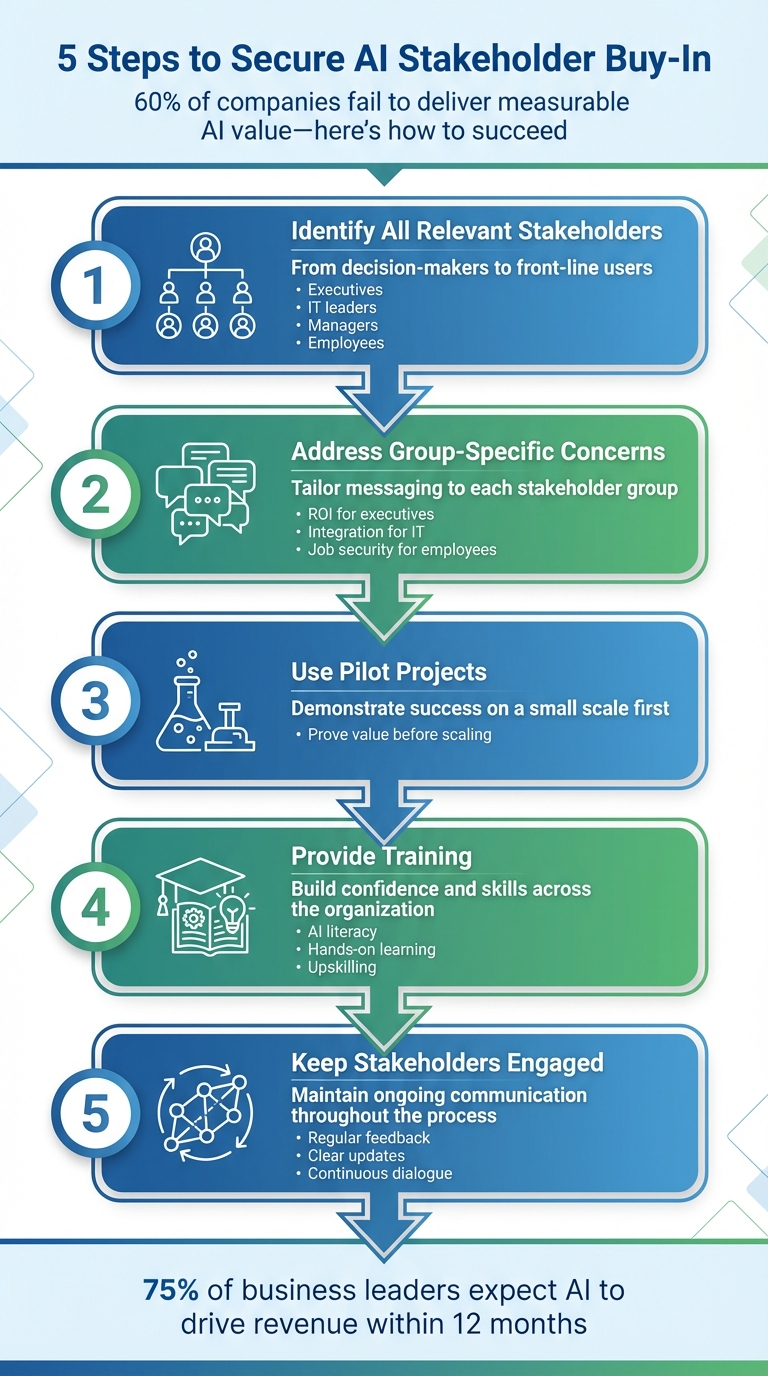
5 Essential Steps to Secure AI Stakeholder Buy-In
LLMs, Gen AI and Stakeholder Buy-in
Identifying and Understanding Your AI Stakeholders
AI projects often falter not because of the technology itself, but because key stakeholders are either left out of the process or their concerns aren't addressed. To avoid this, it's critical to identify everyone whose work or influence impacts the project’s success. This includes not only executives and IT teams but also informal influencers who hold sway through established trust. Below, we’ll explore how to systematically categorize and prioritize these groups.
How to Map Your Stakeholder Groups
Start by listing all stakeholder groups that influence your AI initiative. Here’s a breakdown of key groups and their roles:
- Executive teams (C-level and VPs): These decision-makers control budgets and align projects with strategic goals, focusing on ROI and competitive positioning.
- IT leaders and technical teams: They handle integration, scalability, and maintenance, ensuring AI solutions fit seamlessly into existing systems.
- Operational leaders and department heads: Their focus is on improving efficiency and reducing errors while assessing how workflows will be affected.
- End users and front-line employees: These individuals interact with AI daily, and their buy-in is crucial for adoption. However, they may also have concerns about job security.
Once stakeholders are identified, use an influence-interest matrix to prioritize them. Plot each group based on their level of power and interest in the project:
- High-power, high-interest stakeholders (e.g., executives and key department heads) should be deeply involved in major decisions.
- High-power, low-interest stakeholders (e.g., regulatory bodies) should be kept informed but not overwhelmed with details.
- Low-power, high-interest stakeholders (e.g., front-line employees) should receive regular updates and opportunities to provide feedback, as they can become valuable allies.
What Stakeholders Worry About and What They Want
Different stakeholder groups have distinct priorities and concerns:
- Executives: They often focus on upfront costs and whether AI will deliver measurable ROI. In fact, 62% of C-suite leaders cite a lack of AI talent as a significant barrier to achieving value.
- IT leaders: Their concerns revolve around integration challenges, cybersecurity risks, and the possibility of AI introducing unforeseen issues.
- Operational managers: They look for evidence that AI can reduce processing times and errors without disrupting existing workflows.
- Front-line employees: These workers frequently fear job displacement - a valid concern given that over 19 million U.S. roles (more than 12% of jobs) face a high risk of near-term automation due to AI.
To address these concerns, tailor your messaging for each group:
- For executives, emphasize financial benefits and share success stories, such as Direct Mortgage achieving ROI in July 2024 by automating document handling.
- For IT teams, highlight ease of integration and maintenance while addressing security concerns.
- For operational leaders, provide data on reduced processing times and error rates.
- For employees, focus on how AI will enhance their roles rather than replace them, and outline opportunities for upskilling.
Creating Your Stakeholder Buy-In Strategy
After identifying your stakeholders and understanding their concerns, the next step is crafting a strategy to gain their support. Using insights from your stakeholder map, this section outlines how to tie AI initiatives to meaningful outcomes, tailor your communication to different audiences, and implement training programs that build confidence and skills.
Connecting AI Projects to Business Outcomes
AI projects often fail when they’re pursued as standalone technology experiments rather than tools for achieving concrete business results. As SAP puts it:
"AI isn't valuable on its own. It's valuable when it moves the needle on something the business already cares about".
To succeed, align AI initiatives with your company’s core priorities. Start by identifying use cases that directly address strategic goals. For example, if customer satisfaction is a key focus, consider AI applications that enhance response times or personalize interactions. If cutting costs is the priority, look for repetitive tasks that can be automated. Delta Airlines demonstrated this approach in 2025 by using SAP SuccessFactors to align AI projects with employee satisfaction goals. By analyzing talent data, they filled nearly 50% of managerial positions with customer-facing employees, boosting both customer experience and shareholder value.
It’s crucial to document your starting metrics and define KPIs that clearly connect AI efforts to business outcomes. Microsoft offers a compelling example: by targeting inefficiencies in supply chain forecasting, they reduced manual planning by 50% and improved on-time planning by 75%.
You might also consider creating an AI portfolio - a roadmap that tracks all initiatives and bridges the gap between current capabilities and future needs.
Communicating AI Value to Different Audiences
Different stakeholders prioritize different outcomes, so your messaging needs to reflect their unique concerns. Executives focus on ROI and competitive positioning, while IT teams care about operational improvements. Meanwhile, employees may worry about job security and usability.
| Stakeholder Group | Focus | Metrics |
|---|---|---|
| C-Suite / Executives | Strategic goals, ROI, market edge | Revenue growth, deal size increases (10–30%), cost savings |
| IT Practitioners | Technical feasibility, system reliability | Error rate reduction, operational efficiency, workload improvements |
| Department Managers | Process efficiency, team productivity | Processing time reduction (up to 75%), manual task elimination |
| End-Users / Employees | Job security, ease of use, upskilling | Time saved on routine tasks, new skills acquired, career advancement |
When addressing executives, focus on financial returns and competitive advantages. For example, Chobani achieved a 75% reduction in time spent on expense management, enabling their finance team to shift from routine tasks to strategic planning. For IT teams, highlight seamless integration and robust security. Employees, on the other hand, need reassurance that AI will complement their roles rather than replace them.
It’s essential to address both the logical and emotional concerns of your audience. While executives may want detailed ROI projections, employees often need clarity about how AI will impact their future. As Somya Dwivedi-Burks, Senior L&D Strategist, says:
"Clarity is kindness".
Regular touchpoints, such as Q&A sessions or lunch-and-learn events, can provide opportunities for stakeholders to ask questions and stay informed. For skeptics, tools like ROI calculators or scenario builders can help them test assumptions and see potential benefits firsthand.
Once your messaging is in place, the next step is to ensure your team has the skills needed to bring these AI plans to life.
Building AI Skills Through Training Programs
Even the best AI strategy can fall short without proper training. Training builds confidence, reduces resistance, and demonstrates that AI is a tool employees can learn to use - not something to fear. A strong training program not only equips your team with practical skills but also reinforces trust in AI’s role within your organization.
Start with AI literacy, focusing on what AI can and cannot do. Teach employees how to identify inaccuracies and verify outputs. This foundational knowledge helps managers feel more secure about adopting AI. Then, move on to hands-on training, where employees learn to use specific tools in their day-to-day work. Ricardo Madan, SVP at TEKsystems, emphasizes the importance of upskilling:
"Buying a car without wheels and expecting it to take you where you need to go".
For organizations in Northwest Arkansas, NWA AI offers tailored training programs, including AI literacy workshops, hands-on learning opportunities, and structured adoption strategies. These programs focus on practical applications and don’t require coding skills, making AI accessible to employees at all levels.
Beyond formal training, identify "super users" - team members who frequently engage with AI tools and provide valuable feedback. These individuals can become internal champions for AI adoption. As Mala Anand, Corporate Vice President of Customer Experience and Success at Microsoft, explains:
"These internal champions are instrumental in driving adoption in a truly exponential way. They are the innovators for your journey".
You can also encourage engagement by allocating AI licenses through internal contests where employees pitch their best ideas for AI applications. Additionally, setting aside regular "exploration time" - such as an hour every few weeks - can allow team members to experiment with AI tools and find creative solutions to daily challenges.
sbb-itb-e5dd83f
Engaging Stakeholders Throughout Your AI Project
Once you've laid the groundwork for your AI strategy and completed training - like the programs offered by NWA AI – Northwest Arkansas AI Innovation Hub (https://nwaai.org) - the next step is critical: engaging stakeholders from the planning stages through to full implementation. This is where the real magic happens. By combining effective stakeholder mapping with tailored communication strategies, you can ensure that your project gains traction rather than getting bogged down by confusion or resistance.
Involving Stakeholders from the Start
Getting stakeholders involved early isn't just about collecting feedback - it's about creating a sense of ownership. When people are part of the process from the beginning, they’re more likely to support the project and less likely to resist changes later.
Start by identifying both formal and informal influencers. Sometimes, influence doesn’t align with job titles. For example, a warehouse supervisor might have more sway over a supply chain AI project than their title suggests because their team trusts their judgment. Map out stakeholders by their roles and attitudes - categorizing them as allies, neutrals, skeptics, or objectors - so you can tailor your approach accordingly.
One effective way to build ownership is through co-design sessions. Instead of presenting a polished AI solution, invite stakeholders to help refine it. A great example of this is the 2025 collaboration between Compass Group Australia and Deloitte Australia. They developed an AI system aimed at improving nutrition for older adults. By involving healthcare experts and caregivers early in the design phase, they ensured the system addressed real dietary and health needs.
It's also important to address concerns right away, whether they’re about trust, costs, or lack of knowledge. Acknowledging these issues and involving stakeholders in finding solutions can turn resistance into support. This early collaboration lays the foundation for clear, straightforward communication about AI’s benefits.
Explaining AI Benefits in Plain Language
To win over stakeholders, explain AI’s capabilities in ways that connect directly to their day-to-day responsibilities. Use examples that are specific to their roles. For instance, you might show a customer service manager how an AI tool can simulate tough customer interactions to help team members practice, or demonstrate to a content team lead how AI can automate the creation of quiz questions or style guides, saving hours of effort.
Transparency is key. Be upfront about AI’s limitations, like the risk of "hallucinations" - situations where AI generates inaccurate information - and stress the importance of human oversight. This honesty builds trust. As Somya Dwivedi-Burks, Senior L&D Strategist, wisely says:
"Clarity is kindness".
Position AI as a tool that enhances, rather than replaces, critical thinking. Using AI effectively requires stronger analytical skills - employees need to evaluate results, identify errors, and make informed decisions. This not only keeps them essential to the process but also increases their value.
Create opportunities for ongoing dialogue, like lunch-and-learn sessions or regular forums, where employees can voice concerns and get answers. With 60% of leaders acknowledging that AI expectations outpace their organization’s readiness, these conversations can help set realistic goals and timelines.
For skeptics, hands-on experience can be a game-changer. Develop interactive tools like ROI calculators or scenario builders that let them test AI’s potential impact themselves. This kind of engagement often turns doubters into advocates.
Organizations like NWA AI – Northwest Arkansas AI Innovation Hub (https://nwaai.org) also offer training programs that can deepen stakeholder understanding and involvement.
Once stakeholders understand the benefits, pilot projects can provide the proof they need to fully buy in.
Using Pilot Projects to Prove Value
Pilot projects are a practical way to address skepticism. They let stakeholders see real results on a small scale before committing to a full rollout.
Choose pilot projects that align with your organization’s strategic goals. For example, if improving customer experience is a top priority, test an AI tool designed to enhance customer interactions. If cutting costs is the focus, try automating a repetitive task. By aligning pilots with key objectives, you ensure the results resonate with decision-makers who control budgets and resources.
In December 2025, Rakuten Securities ran a pilot using an AI avatar for customer interactions. The results? Improved user engagement, which demonstrated the tool’s potential value.
Before launching a pilot, define what success looks like. Different stakeholders will have different priorities - executives might focus on cost savings, while operational managers care more about reducing errors or improving efficiency. Establish baseline metrics so you can clearly show improvements.
Treat pilots as opportunities to learn. Share both successes and setbacks openly. When stakeholders see that you’re refining the tool based on real feedback, it builds confidence that the final implementation will meet their needs. This approach aligns with the fact that 75% of business leaders expect AI to drive revenue within 12 months.
Take Purolator’s collaboration with Deloitte, for example. They used AI to create a fleet decarbonization roadmap, starting with a pilot project. By involving stakeholders across the logistics chain and demonstrating early success, they built the confidence needed to scale the initiative and work toward their net-zero goals.
Small wins from pilot projects can generate momentum. When teams see tangible improvements, the abstract promise of AI becomes a reality they can rally behind.
Maintaining Support as AI Expands
Once pilot programs demonstrate their potential, the real challenge begins: keeping stakeholders engaged as AI becomes a routine part of operations. The numbers paint a stark picture - between 70% and 90% of enterprise AI projects fail to progress beyond the pilot stage. By 2025, enterprises are expected to abandon nearly half of their AI pilots before reaching production. The key difference between success and failure often lies in how effectively organizations transition from experimental projects to operational tools.
Managing Change as AI Becomes Part of Daily Work
Scaling AI requires a shift in mindset: integrating AI into the fabric of daily work. This involves treating AI like a product, requiring robust engineering, ongoing user training, and dedicated long-term support.
To start, redefine roles and responsibilities to align with this new reality. Frontline managers play a critical role in driving adoption by modeling positive attitudes toward AI and empowering their teams locally. As Nufar Gaspar, Director of AI Everywhere at Intel, explains:
"Managers matter when it comes to AI adoption and their proper involvement is instrumental to overcoming the astounding rate of AI projects failures".
When managers actively use AI, it signals to employees that AI is here to stay.
Performance metrics should also evolve to reflect AI integration. Instead of tracking surface-level data, like login counts, focus on how AI is transforming workflows and becoming central to key activities. For instance, organizations that successfully scale AI see three times higher revenue impacts and a 30% increase in EBIT compared to those stuck in pilot phases. Clear, measurable goals - such as reducing downtime by 30% - help connect AI efforts to tangible business outcomes.
Incentives should shift from recognizing individual "AI superstars" to rewarding team performance. This encourages collaboration and prevents AI adoption from being siloed. When teams succeed together, they’re more likely to support one another through the challenges of learning and adapting.
This operational shift lays the groundwork for sustained learning and engagement.
Continuing Education and Skill Development
As AI tools evolve, so must employee skills. Continuous learning is crucial to maintaining stakeholder confidence and ensuring employees keep pace with technological advancements.
One way to structure this is by defining clear "AI personas", which outline who needs what level of skill. A common framework, the "AI Skills Pyramid", consists of three tiers:
- Everyone: Basic concepts to reduce fear and build comfort.
- AI Champions: Departmental leads who mentor their peers.
- AI Experts: Technical staff responsible for building and maintaining solutions.
This approach helps individuals understand their role in the AI ecosystem and what’s expected of them.
It’s also essential to formally allocate time for skill development. Currently, less than 25% of employees’ AI training occurs during work hours. When learning becomes an after-hours burden, it leads to burnout and resistance. Setting aside work hours for upskilling ensures employees can grow their skills without added stress.
Organizations like NWA AI – Northwest Arkansas AI Innovation Hub (https://nwaai.org) offer training programs tailored to expanding AI capabilities. These programs include AI literacy courses, hands-on tool development, and strategies for organizational adoption, catering to diverse skill levels and eliminating the need for coding expertise.
Creating communities of practice is another effective strategy. Dedicated spaces - such as Slack channels for AI discussions or regular lunch-and-learn sessions - allow employees to ask questions, share successes, and learn from peers. Peer-to-peer learning is highly valued, with 69% of employees ranking it among the top ways to build AI skills.
Tracking Engagement and Improving Your Approach
Monitoring stakeholder engagement is vital for identifying problems early. This requires building on initial stakeholder mapping and continuously refining your approach.
Classify stakeholders based on how they adopt AI:
- AI Champions: Early adopters who lead the way.
- Independent Explorers: Self-starters eager to experiment.
- Organizational Adopters: Those who follow structured processes.
- Passive Observers: Hesitant participants.
- Cautious Skeptics: Those resistant to change.
Each group needs tailored engagement strategies. For example, while Champions can serve as peer coaches, skeptics may benefit from small, fact-based forums that showcase real-world improvements rather than abstract promises.
Tackle skepticism directly. With 60% of companies failing to generate meaningful value from AI despite significant investments, doubt is understandable. Role-specific pilots and peer demonstrations can help bridge the "belief gap." For instance, a skeptical manager is more likely to embrace AI after seeing a colleague successfully use it to solve a shared challenge.
Establish feedback loops through surveys, focus groups, or one-on-one discussions. Ask targeted questions: Are employees using the tools? What obstacles are they facing? What additional support is needed? Only 25% of frontline employees report receiving adequate guidance from leadership on effective AI use, highlighting room for improvement.
Track both the number of users and the depth of AI integration. As Matt Nigh, Program Manager Director of AI at GitHub, notes:
"The difference between success and failure isn't buying licenses. It's building the human infrastructure that turns skeptical employees into power users".
Lastly, remember that your AI strategy must remain flexible. As Pieter den Hamer from Gartner points out:
"AI strategy can't be set and frozen - nor seen and executed in isolation".
Maintaining AI adoption requires treating stakeholder engagement as an ongoing dialogue. Organizations that succeed are those that stay adaptable, listen actively, and continually refine their approach based on feedback and results.
Conclusion
Gaining stakeholder support for AI isn't a one-off effort - it’s an ongoing dialogue that stretches from early planning stages to long-term integration. Organizations that succeed view AI as more than just a tech upgrade; they see it as a transformation that touches every aspect of their operations - people, processes, and workplace culture.
The key lies in deeply understanding your stakeholders, as discussed earlier. By aligning your communication with their priorities, you can build trust more effectively. However, challenges like skepticism, upfront costs, and limited AI knowledge often stand in the way.
One way to overcome these obstacles is by showcasing value through phased rollouts. For example, quick wins and pilot projects - like Direct Mortgage's AI-driven automation initiative in July 2024 - can demonstrate measurable benefits and deliver a fast return on investment before scaling further.
Beyond these early successes, strong leadership plays a critical role in driving AI adoption. When senior leaders champion AI and encourage ongoing learning, they send a clear message: this transformation is here to stay. Today, 88% of companies are using AI in at least one area of their business, and those with more advanced AI strategies are consistently outperforming industry benchmarks financially. The real differentiator, however, is building the right human infrastructure. Programs like those offered by NWA AI – Northwest Arkansas AI Innovation Hub are essential for turning hesitant employees into confident AI users.
An effective AI strategy must remain adaptable. Regular feedback loops, clear communication, and celebrating milestones can keep stakeholders engaged as AI becomes part of everyday operations. With 75% of business leaders expecting AI initiatives to boost revenue within a year, the pressure to deliver is undeniable. The key to success lies in maintaining an evolving conversation with stakeholders, ensuring your AI journey grows stronger with every step forward. This ongoing engagement is what drives lasting transformation across your organization.
FAQs
How can I address the concerns of different stakeholders when introducing AI in my organization?
Effectively addressing stakeholder concerns begins with understanding what matters most to each group. Executives are typically focused on measurable outcomes like revenue growth or cost savings that align with organizational goals. Show them how your AI solution delivers a strong ROI and contributes to the company's strategic objectives. IT leaders, on the other hand, care about integration, security, and scalability. Provide detailed plans that outline compliance measures, phased rollouts, and strategies to minimize disruptions during implementation.
For operational managers, concerns often revolve around workflow changes or the potential for job displacement. Ease their worries by demonstrating how AI can enhance productivity through pilot programs and examples of real-world success. Meanwhile, Learning and Development (L&D) teams are focused on addressing skill gaps. Offering hands-on, no-code training sessions can help build AI literacy and empower the workforce to adapt to new technologies.
Building trust is crucial. Involve end-users early in the process, address concerns about fairness and transparency, and create feedback loops to ensure continuous improvement. Highlight specific successes - like achieving a $250,000 cost reduction in the first quarter - and keep stakeholders engaged with regular updates. By tailoring your communication and support to each group, you can turn potential resistance into advocacy and pave the way for a smooth AI adoption journey.
How can we keep stakeholders engaged as AI projects grow beyond the pilot phase?
To keep stakeholders engaged as AI projects grow, focus on delivering measurable results and encouraging active collaboration. Start by highlighting the business impact with concrete metrics - like showing cost reductions in dollars or productivity gains measured in hours. Share updates regularly, syncing them with executive review schedules to maintain interest and momentum.
Bring more stakeholders into the fold by creating spaces for participation and feedback. This could mean hosting workshops, running user-testing sessions, or organizing open forums where employees can voice their ideas and concerns. Tailor your communication and training efforts to suit different audiences - whether it’s technical teams or business leaders - so everyone feels prepared and motivated to contribute to the AI journey.
Lastly, set up flexible governance with cross-functional teams that meet consistently to monitor progress, tackle challenges, and adjust priorities as needed. By combining clear metrics, inclusive collaboration, and adaptable oversight, you can keep stakeholders engaged and enthusiastic as AI projects evolve within the organization.
How can I ensure my AI initiatives align with my company's business goals?
To make sure your AI initiatives align with your company's goals, start by laying out your organization's strategic objectives in clear terms. Pinpoint and rank AI use cases that directly connect to these objectives, with an emphasis on measurable results and specific ROI goals. Develop a roadmap that links each AI project to tangible business outcomes, ensuring everything stays in sync with your broader strategy.
Consistently evaluate how AI projects are performing against your strategic plan, tweaking them as needed to stay aligned. Implement strong governance practices to keep efforts focused and ensure your AI initiatives continue to support your company's priorities.
Build real AI capability on your work
The AI training programs are part of how Northwest Arkansas is approaching AI adoption.
Get involvedRelated Articles

ROI and KPIs in AI Process Optimization
Measure AI impact with ROI and KPIs: set baselines, track hard and soft ROI, and monitor model, system, and business KPIs to validate performance and value.

How Blended Learning Improves AI Upskilling
Blended learning, online modules plus hands-on workshops, boosts AI skill retention, engagement, and real-world application for faster workplace upskilling.

5 Steps to Define AI Workflow Goals
Set measurable AI workflow goals in five steps: map processes, set SMART targets, pinpoint AI opportunities, define KPIs, and align with strategy.