
How To Identify AI Use Cases For Business
NWA AI Team
Editor

How To Identify AI Use Cases For Business
To effectively use AI in your business, start by identifying problems or opportunities that AI can address. Focus on areas where AI can save time, cut costs, or improve outcomes. Here’s a simple process to get started:
- Align AI with Goals: Tie AI efforts to measurable business objectives, like reducing costs or improving customer satisfaction.
- Pinpoint Challenges: Use frameworks like the 4P’s (Problem, Process, Potential, Proposal) to map out specific issues AI can solve.
- Set KPIs: Define clear metrics to track AI’s impact, such as operational efficiency or customer experience improvements.
- Spot Opportunities: Break down workflows to identify repetitive tasks or bottlenecks where AI can add value.
- Prioritize Use Cases: Use tools like the Impact-Effort Matrix to focus on high-value, low-effort projects first.
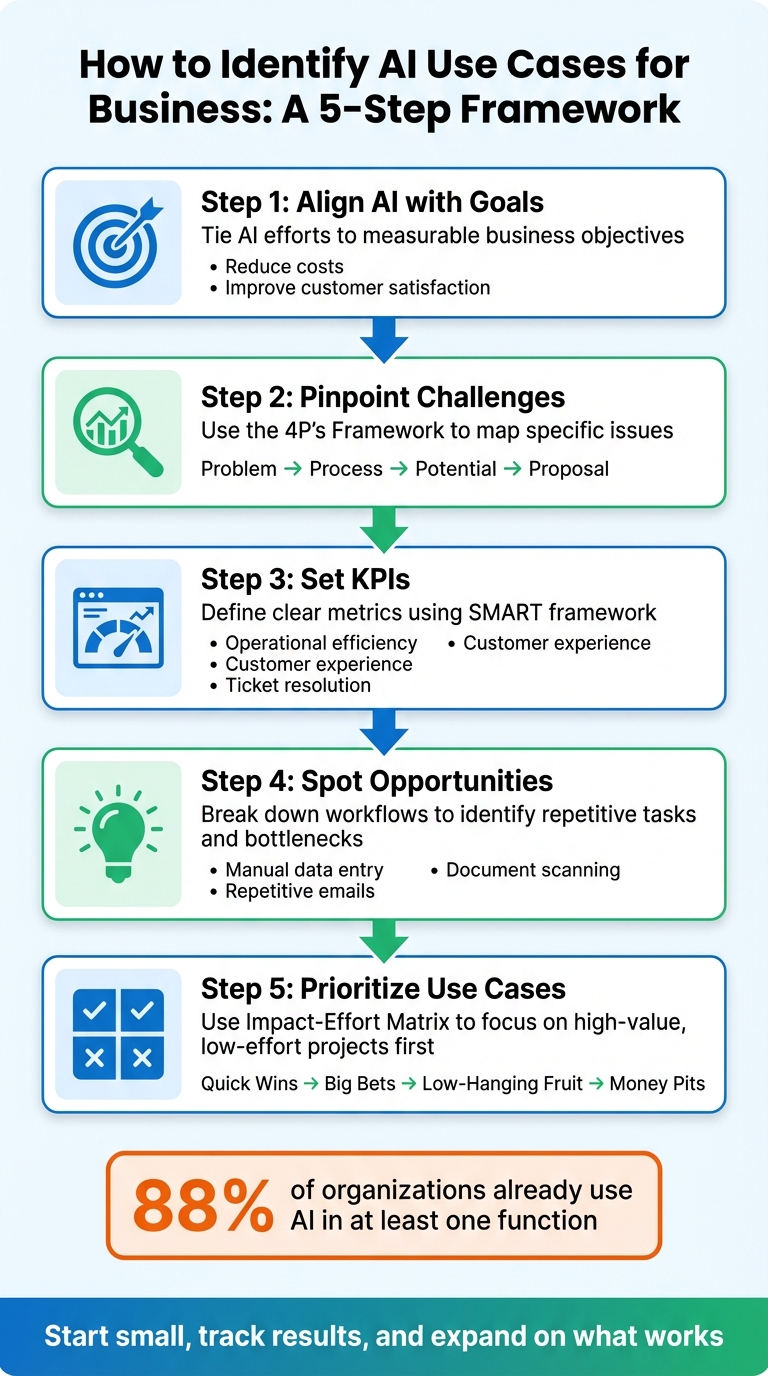
5-Step Process to Identify AI Use Cases for Business
How to Identify High-ROI Use Cases for AI in Your Business
sbb-itb-e5dd83f
Align AI Use Cases with Business Goals
The best AI projects start by tying each use case to a specific, measurable business goal - not by diving headfirst into the technology. This ensures that resources are spent on practical, impactful solutions rather than flashy, but ultimately unproductive, experiments.
This alignment also plays a critical role in deciding which initiatives receive funding. As Pieter den Hamer, VP Analyst at Gartner, puts it:
"Alignment between AI and business strategy must be bidirectional. Business goals shape your AI agenda, but emerging AI capabilities can - and should - influence business direction".
In short, your business priorities should guide where AI investments go, but cutting-edge AI developments might also open up new opportunities you hadn’t previously considered. Without this alignment, proving value becomes a challenge, which can make it harder to secure the budget and support needed for future projects. Early successes that deliver measurable results lay the groundwork for scaling up AI efforts.
Define Your Business Objectives and Challenges
Once you've established alignment, the next step is identifying the challenges that matter most to your business. Instead of asking, “Where can we use AI?”, focus on pinpointing the specific problems that are holding you back. This approach ensures you’re solving real issues rather than experimenting with technology for its own sake.
The 4P's Framework is a useful tool for this process. It helps you break down challenges into four parts:
- Problem: What’s the negative impact you’re facing?
- Process: What steps are contributing to this issue?
- Potential: What’s the outcome you’re aiming for?
- Proposal: Which AI solutions could help?
For instance, if long wait times in customer support are dragging down satisfaction scores, start by mapping out the current ticket-routing process. Then, define your target response time and explore AI options like intelligent triage or chatbots. It’s crucial to analyze workflows at the task level rather than focusing on entire roles. For example, in a customer service role, tasks like data entry and follow-up scheduling may be ideal for automation, while empathetic problem-solving remains better suited for humans.
Workshops and process reviews with frontline teams can uncover inefficiencies you might not see from the top. These collaborative efforts help identify pain points and guide the next steps in evaluating AI opportunities.
Set Key Performance Indicators (KPIs) for AI Integration
Once you’ve nailed down the challenges, it’s time to turn them into measurable KPIs. Use the SMART framework to ensure your KPIs are Specific, Measurable, Attainable, Realistic, and Time-Bound. For example, “Increase first-contact resolution rate from 65% to 80% within six months” sets a clear, actionable goal, whereas “improve customer service” is too vague to be useful.
Start by establishing baseline metrics for your current performance. Track data like cycle times, error rates, or staffing hours. Without this baseline, you won’t be able to measure ROI or prove that AI is making a difference.
Here’s a quick look at some KPI categories and examples:
| KPI Category | Example Metrics |
|---|---|
| Operational Efficiency | Reduction in operational costs; fewer agent hours spent on repetitive tasks |
| Customer Experience | Higher CSAT/NPS scores; increased positive feedback sentiment |
| Ticket Resolution | Percentage of issues resolved without human intervention; improved first-contact resolution rates |
| Business Growth | Greater request volumes handled without adding staff |
It’s important to balance leading indicators (which predict future outcomes, like customer engagement) with lagging indicators (which show past results, like monthly sales). For an AI chatbot, a lagging indicator might be the total number of tickets resolved, while a leading indicator could be user satisfaction scores after interactions.
Set clear exit criteria for pilots upfront. Define the performance improvements, error thresholds, or cost limits that will determine whether to continue, modify, or abandon a project. For example, if an AI assistant doesn’t hit its performance goals during testing, you’ll need to decide whether to refine the approach, shift focus, or shut it down. These decision points prevent projects from dragging on without delivering any real value.
Finally, assign someone to own and track each KPI. This accountability ensures progress stays on track and that your AI initiatives deliver measurable results.
Assess Areas for AI Opportunities
Once you've aligned AI with your goals and set clear KPIs, the next step is to identify where AI can streamline operations. This involves taking a close look at your workflows to spot tasks that consume excessive time and resources.
Start by breaking down roles into smaller tasks. Rama Ramakrishnan, Professor of the Practice at MIT Sloan, explains:
"That's why you need to go through the trouble of breaking jobs up into individual, discrete tasks. Some things are easy with an LLM while other things are really hard".
Take a professor's job, for example. While their overall role can't be automated, specific tasks like grading assignments or preparing course materials can be handled by AI.
Mapping out workflows is a great way to identify inefficiencies. Look for tasks involving manual data entry, scanning documents, synthesizing information, or writing repetitive emails. Also, review existing tools like macros, algorithms, and dashboards - they may represent early automation efforts that can be upgraded with AI.
Another effective tactic is internal crowdsourcing. Workshops, hackathons, and surveys can help you gather insights from employees about their daily challenges. With 88% of organizations already using AI in at least one function, this approach can guide you in pinpointing areas for improvement.
Identify Repetitive and Time-Consuming Tasks
AI shines in repetitive tasks. Start by documenting how long these tasks currently take. For instance, if a team spends "3 hours per report" or "45 minutes per customer inquiry", tracking these durations creates a baseline to measure improvements.
Focus on processes that involve large volumes of data or are prone to errors - these often yield the best returns. To visualize potential gains, create a before-and-after comparison chart. For example, if summarizing reports takes 10 hours a week, an AI tool might cut that down to 2 hours while improving consistency.
Here’s a quick look at common AI applications:
| AI Function | What It Does | Business Example |
|---|---|---|
| Accelerate | Speeds up repetitive tasks | Synthesizing large reports for key highlights |
| Automate | Performs actions autonomously | Monitoring financial close checklists and sending alerts for missed deadlines |
| Analysis | Extracts insights from data | Identifying gaps in risk coverage within spreadsheets |
| Research | Answers questions faster | Analyzing alignment with new sustainability guidance |
| Create | Generates new content | Drafting earnings call scripts using proprietary data |
When evaluating tasks, consider the AI Cost Equation: weigh the costs of maintaining the current process against the expenses of AI, such as licensing fees, API usage, and time spent verifying outputs. For high-stakes areas like healthcare or legal work, include the cost of human oversight.
Beyond repetitive tasks, explore inefficiencies within broader workflows.
Evaluate Processes With Inefficiencies or Bottlenecks
Look for workflows that lead to delays, errors, or frustration. For example, high volumes of repetitive communication - like customer service teams handling similar inquiries or sales teams manually following up on leads - can be streamlined with AI. Similarly, processes requiring frequent data reconciliation between systems can waste time and increase errors. Quantify the hours spent on these tasks to estimate potential savings.
Another area to examine is knowledge work friction. AI tools are highly effective at speeding up tasks like data searches, summaries, and retrieval. Natalie Denman, Audit Supervisor at Flowserve, shared:
"Workiva AI helps us analyze long-form text responses from surveys, identifying common themes and concerns, such as regulatory changes, thereby streamlining our reporting with less manual tasks".
Also, identify operational blind spots where tracking is limited. This could include monitoring shopper behavior, tracking popular items, or assessing real-time equipment performance. If maintenance is only performed after equipment fails, consider predictive AI solutions to anticipate issues and reduce costs.
To evaluate inefficiencies, use a scoring system. For instance, an AI assessment questionnaire might recommend immediate action for scores above 41, while scores between 19 and 40 could highlight areas requiring further preparation.
Explore AI Potential Across Departments
AI has applications across nearly every department, but its use depends on specific challenges and workflows. Align opportunities with the efficiency improvements identified earlier.
- Sales teams can use AI for automated prospecting, lead scoring, and forecasting to improve pipeline accuracy.
- Customer service can deploy AI agents and sentiment analysis tools to enhance satisfaction while cutting costs.
- Marketing teams can benefit from personalized recommendations and automated content creation.
- Operations can implement dynamic pricing and predictive maintenance for greater efficiency.
- IT and AIOps can leverage AI for root cause analysis, automated coding, and reducing mean time to repair (MTTR).
- Finance departments can automate tasks like fraud detection and client need forecasting.
- HR teams can streamline application screening and deploy FAQ bots to improve hiring processes.
- Manufacturing can use AI-powered factory assistants to troubleshoot equipment issues, reducing downtime and boosting productivity.
The key is to match AI capabilities to each department's needs. As the Microsoft Cloud Adoption Framework puts it:
"Successful AI programs anchor each use case to a quantified business objective, not a model-first experiment".
Looking ahead, 81% of decision-makers believe AI will improve reporting and audit processes by 2027, and 71% of investors already rely on AI to evaluate company performance.
Gather and Inventory Potential Use Cases
Once you've pinpointed areas where AI can make a difference, the next step is to systematically collect and organize these opportunities. This process turns scattered ideas into a structured inventory that you can evaluate and prioritize.
One of the best ways to gather use cases is through cross-functional workshops. Bring together executive sponsors, data owners, operations leaders, product managers, and end-users to align technical feasibility with business goals. Companies excelling in AI often use this method to scale twice as many AI use cases as their peers.
Before hosting a workshop, take time to prepare. Conduct brief interviews with stakeholders, review documents like OKRs and data maps, and survey teams to uncover internal challenges. This preparation ensures that discussions stay focused and productive.
To make ideas actionable, use tools like "Use Case Cards" or digital whiteboards. For each idea, clearly define the problem, the potential impact on revenue or efficiency, the availability of data, and who owns the process. As InitializeAI puts it:
"AI success is rarely about the model - it's about stakeholder alignment, data readiness, and organizational momentum".
Data audits are just as essential. Incorporate a data review into your workshop to confirm that the necessary data is clean, well-labeled, and accessible. Document all data sources - such as databases, APIs, IoT devices, and third-party platforms - and assess their quality, completeness, and accuracy. A "Readiness Radar" can help you visualize gaps in data, skills, or infrastructure. Microsoft underscores this with:
"Your data strategy is the control plane for scalable, trustworthy AI".
Conduct Team Workshops and Data Audits
With your business challenges and AI opportunities outlined, the next step is to consolidate these ideas through workshops and audits.
A well-structured workshop is key to success. Here's a sample agenda that keeps participants on track:
| Time | Activity | Objective |
|---|---|---|
| 09:00 | Welcome & Goals | Align everyone on the workshop's purpose. |
| 09:15 | AI Demystified | Educate the team on AI capabilities. |
| 09:45 | Current State Mapping | Identify bottlenecks and repetitive tasks. |
| 10:45 | Use Case Brainstorming | Document specific AI opportunities. |
| 11:30 | Prioritization Exercise | Use a 2x2 matrix to select high-impact pilots. |
| 12:00 | Roadmap & Next Steps | Assign owners and outline 30-60-90 day plans. |
Start small by piloting this approach in one department. Focus on the "why" behind AI initiatives rather than jumping straight into models.
For data audits, assess your organization's data maturity. Level 1 organizations with limited data might begin with basic Copilot solutions, while Level 3 organizations with extensive historical datasets can explore custom machine-learning models like Retrieval Augmented Generation (RAG). Tools like Microsoft Purview or Microsoft Fabric can help you track data usage and ensure compliance throughout its lifecycle.
Encourage employees to share ideas by introducing workforce incentives. Host hackathons, create Slack channels, or set up idea-sharing platforms to tap into the insights of those closest to daily operations.
Once you've gathered use cases, the next step is to organize them systematically for evaluation.
Organize Use Cases in a Comparison Framework
After collecting ideas, arrange them in a comparison framework to make evaluation easier. A well-designed table can reveal patterns and shared data needs.
Here's an example of how to structure it:
| Department | Problem | AI Opportunity | Data Needs |
|---|---|---|---|
| Sales | Manual lead qualification is inefficient | Automated prospecting with AI agents | CRM data, lead interaction history |
| Customer Service | High volume of repetitive questions | AI service agents for web and mobile apps | Knowledge base, FAQs, transcripts |
| Operations | Difficulty predicting equipment failure | Predictive maintenance for repairs | Sensor data, maintenance logs |
| Finance | Hard-to-spot suspicious transactions | Fraud detection using ML models | Transaction history, user metadata |
| Marketing | Low conversion on generic promotions | Personalized product recommendations | User preferences, purchase history |
Document each use case using the 4P's framework: Problem (negative impact), Process (steps causing the issue), Potential (desired outcomes), and Proposal (available AI solutions). This ensures you capture the necessary details for informed decision-making.
To evaluate use cases, apply the BXT Framework, which considers Business (ROI and viability), Experience (user desirability), and Technology (feasibility and risks). Assign each use case a score from 1 to 5 based on how well it aligns with business objectives and stakeholder needs.
Classify use cases by their implementation path: SaaS for ready-to-use solutions, PaaS for custom tools like Azure Foundry, or IaaS for advanced model training. This helps you estimate the resources and timelines required.
For prioritized use cases, define clear KPIs - such as reducing operational costs by a specific percentage - to measure success. Use a scoring questionnaire to determine whether AI is the best solution: scores above 41 indicate readiness, while scores between 19 and 40 suggest a cautious approach.
This structured approach ensures that your inventory is ready for the next phase: prioritizing which use cases to tackle first based on their impact and feasibility.
Prioritize High-Impact Use Cases
Now that you’ve organized your inventory of AI opportunities, it’s time to figure out which ones deserve your immediate attention. This step is critical - it’s where good intentions turn into actionable strategies. Prioritizing effectively is what separates successful AI projects from those that stall out.
One simple yet effective tool for this is the Impact-Effort Matrix. This framework helps categorize your use cases into four clear quadrants:
- Quick Wins: These are high-value, low-effort projects. They’re perfect for building momentum and showing quick returns.
- Big Bets: High-value initiatives that require significant effort and resources. These are long-term projects with transformative potential.
- Low-Hanging Fruit: Low-value, low-effort tasks. These can be tackled when resources allow or used to fill gaps between bigger projects.
- Money Pits: Low-value, high-effort endeavors. These should be avoided to save time and resources.
While the Impact-Effort Matrix helps identify immediate opportunities, a more detailed framework can refine your choices. Enter the BXT Framework. This approach uses a weighted scoring model, allocating a 100-point budget across criteria like business value, data readiness, compliance risk, and time-to-value. To make this process even more collaborative, conduct a prioritization sprint where team members independently score each use case. Adding a confidence level (on a scale of 1–5) for each score can further clarify which initiatives to pursue first.
As CIGen puts it:
"Most AI initiatives fail for predictable reasons: the problem is poorly scoped, the data is unavailable or unfit, the value is unproven, or the solution is hard to operate at scale. Prioritization is how you surface those constraints early and choose battles you can win."
Apply Impact/Effort or BXT Framework
Tie your prioritization efforts directly to your organization’s KPIs for AI integration. A systematic scoring process forces clarity about what truly matters. For example, give stakeholders a 100-point budget to allocate across factors like business value, data readiness, compliance risk, and time-to-value. This ensures alignment with strategic goals and helps avoid chasing low-impact initiatives.
Focus on ROI and Feasibility
Once you’ve scored your use cases, the next step is to ensure they deliver real, measurable returns. The key here is balancing value with feasibility.
For ROI, consider factors like increased revenue, cost savings, risk reduction, and better forecasting. Don’t forget qualitative benefits, too - improved customer experience, talent retention, and competitive differentiation can be just as important.
Take these examples from 2025:
- Chobani used AI to overhaul its financial processes, cutting time spent on expense management by 75%. This freed up their finance team to focus on strategic analysis.
- Nestlé implemented AI tools in SAP Concur, eliminating manual expense management tasks and tripling reporting efficiency.
- SA Power Networks saved $1 million in a single year by using AI to predict and prevent infrastructure corrosion, achieving a 99% success rate in identifying at-risk poles.
To calculate total cost of ownership (TCO), consider all expenses - build, run, and hidden costs like licensing, infrastructure, and data labeling. Compare these costs to your current KPIs, such as processing times, error rates, and operational expenses, to determine realistic payback periods.
Feasibility is equally important. Look at:
- Technical readiness: Is the technology mature and compatible with your existing systems?
- Data readiness: Do you have the historical data needed, and is it of good quality?
- Operational readiness: Does your team have the skills? Is there executive buy-in? Are you prepared for the change management challenges?
If a high-value use case scores poorly on data readiness, don’t abandon it. Instead, pair it with a targeted data initiative to address the gaps.
Before launching a pilot, establish clear exit criteria. For example, set targets for error reduction or cost ceilings that must be met to justify further investment. Start with projects that can be executed within six months using off-the-shelf solutions to quickly show measurable results.
As MIT Sloan Professor Rama Ramakrishnan advises:
"The way to get past that dichotomous, paralytic state is to say we are going to do low-stakes, easy things first and see what happens, but we are going to do lots of them very quickly."
Use NWA AI Training for Implementation
Once you've prioritized your use cases, the next step is implementation, which requires both a skilled workforce and a clear plan. Identifying high-impact use cases is just the beginning - bringing them to life is where the real work begins.
Adopting AI successfully goes beyond picking the right tools. It hinges on thorough training that equips employees with the necessary technical skills and prepares them to embrace AI-driven solutions. Without this foundation, even the best-laid plans can falter.
Upskill Teams With AI Literacy and Tools
NWA AI's AI Literacy and AI Leverage programs offer hands-on training designed to help non-technical teams turn AI opportunities into actionable results. These programs teach employees how to use tools like ChatGPT, enabling departments such as finance, legal, support, and operations to document workflows and identify areas ripe for automation.
The best place to start? Repetitive and menial tasks. These are easier to automate, deliver faster ROI, and help build trust among stakeholders who may be hesitant. When non-technical staff use AI to streamline routine work, they free up time for more strategic, high-value activities. In fact, 88% of practitioners report improved ROI with AI, and 81% of decision-makers predict AI will significantly enhance reporting and auditing processes by 2027.
To ensure knowledge is effectively transferred, consider establishing a Learning Management System (LMS) to track participation in AI training programs across your organization. Additionally, offering incentives can spark innovation and encourage collaboration across departments. This approach ensures AI adoption expands beyond a single team and becomes an organization-wide effort.
With improved skills and boosted confidence, your team will be better equipped to take on a broader AI strategy.
Develop AI Adoption Strategies
Building on improved AI literacy, the next step is crafting a solid strategy to integrate AI seamlessly and overcome resistance. Training your workforce is critical, but it’s only part of the equation. You’ll also need a clear plan to address resistance and drive implementation. This is where NWA AI's AI Adoption program shines, helping organizations create frameworks to tackle policy, process, operational, and workplace challenges.
Effective change management plays a pivotal role in this phase. Resistance can be minimized through targeted training and clear usage guidelines, ensuring smoother transitions and higher adoption rates. A RACI Matrix can help clarify AI-related roles and responsibilities while restricting AI usage to approved employees and specific tasks.
As Microsoft aptly states:
"A documented AI strategy produces consistent, faster, auditable outcomes compared to ad-hoc experimentation".
Start with "Quick Wins" - projects that are high-impact but low-effort. These deliver measurable results quickly and help build momentum for your larger AI initiatives. Encourage collaboration by hosting hackathons, workshops, and setting up dedicated communication channels for knowledge sharing. Additionally, implement continuous feedback systems, such as thumbs-up or thumbs-down options on AI outputs, to monitor and refine performance over time.
Conclusion
Pinpointing the right AI use cases isn't about jumping on the latest tech trends - it’s about solving real business problems and delivering measurable results. Organizations that tie AI efforts directly to clear business goals - like boosting revenue, cutting costs, or enhancing customer experiences - position themselves for long-term success. Without this strategic alignment, AI projects risk becoming isolated experiments that fail to deliver meaningful impact.
To adopt AI effectively, start with a clear understanding of your business objectives and assess where AI can make the biggest difference. Break down workflows into smaller tasks, host team workshops, and use tools like the impact-effort matrix to prioritize initiatives. This helps create a backlog of "quick wins" that build momentum and prove ROI early on. Once priorities are set, it’s essential to prepare your teams for successful AI integration.
But identifying use cases is just the beginning. Success depends on having skilled people and a well-defined strategy. Companies that take a structured approach often scale twice as many AI initiatives compared to others. Resources like NWA AI's training programs play a pivotal role here, equipping non-technical teams with the knowledge and skills they need to make AI a driver of real change.
As Microsoft’s Cloud Adoption Framework puts it:
"A documented AI strategy produces consistent, faster, auditable outcomes compared to ad-hoc experimentation".
The formula is simple: start small, track results, and expand on what works. By following this methodical approach and investing in your team’s development, you can transform AI into a practical, results-driven tool. Use these principles to keep driving innovation and measurable success throughout your organization.
FAQs
How can I identify AI use cases that align with my business goals?
To pinpoint AI use cases that align with your business goals, begin by defining what you want to achieve. Are you aiming to boost revenue, cut costs, or enhance customer satisfaction? Once your objectives are clear, look for specific challenges or opportunities that directly tie to these goals and could benefit from AI-driven solutions.
Next, assess whether you have access to reliable, high-quality data related to these challenges. AI thrives on strong data to deliver meaningful results. Focus on use cases that offer both substantial potential value and practical feasibility. Prioritize those with a clear implementation path and measurable outcomes.
For a successful rollout, map out a detailed roadmap for your selected use case. Secure leadership backing and ensure the plan integrates seamlessly with your team's existing workflows. You might also explore resources like NWA AI – Northwest Arkansas AI Innovation Hub to strengthen your team's AI knowledge and drive forward-thinking solutions effectively.
How can businesses identify the best AI opportunities?
To discover impactful AI opportunities, start by defining your business goals and challenges. Think about key objectives like boosting revenue, cutting costs, enhancing customer experiences, or simplifying operations. Break down the processes tied to these goals to pinpoint where decisions and data already play a role.
Then, engage teams across your organization to gather diverse input. Evaluate ideas based on factors like potential business value, the availability of relevant data, technical feasibility, and how well they align with your overall strategy. Once you’ve collected ideas, prioritize them using a scoring system that weighs value (such as cost savings or revenue growth) against feasibility. This process will help you rank use cases and create a focused roadmap.
When you’ve identified your top opportunity, run a small-scale pilot project to validate its potential and build support for a larger rollout. If your business is in Northwest Arkansas, the NWA AI – Northwest Arkansas AI Innovation Hub provides hands-on training and support to guide you through this journey. They help organizations identify and implement impactful AI solutions, no coding knowledge required.
How can I successfully implement AI across my organization?
To successfully integrate AI into your organization, start by pinpointing your business goals. Clearly define the challenges you aim to tackle - whether it’s cutting down on repetitive tasks, speeding up customer service, or streamlining operations - and set measurable outcomes to track progress.
Bring together a cross-functional team that includes members from IT, data, operations, and the departments directly impacted by the AI tools. This team should oversee key aspects like governance policies, data quality standards, and performance metrics. Start small with a pilot project in a single department to test the waters, fine-tune the solution, and address any issues before rolling it out company-wide.
Don’t overlook the importance of workforce training. Equip your team with the skills they need to use AI effectively. Programs like those offered by NWA AI can provide practical, non-coding training to help employees integrate AI into their daily tasks. Keep a close eye on performance, actively seek feedback, and record lessons learned - this will help refine your approach for future initiatives. By aligning AI initiatives with your business strategy, encouraging teamwork, and prioritizing employee education, you’ll set the stage for long-term success with AI.
Build real AI capability on your work
The AI training programs are part of how Northwest Arkansas is approaching AI adoption.
Get involvedRelated Articles

ROI and KPIs in AI Process Optimization
Measure AI impact with ROI and KPIs: set baselines, track hard and soft ROI, and monitor model, system, and business KPIs to validate performance and value.

How Blended Learning Improves AI Upskilling
Blended learning, online modules plus hands-on workshops, boosts AI skill retention, engagement, and real-world application for faster workplace upskilling.

5 Steps to Define AI Workflow Goals
Set measurable AI workflow goals in five steps: map processes, set SMART targets, pinpoint AI opportunities, define KPIs, and align with strategy.