
AI Upskilling ROI: Measuring Workforce Impact
NWA AI Team
Editor

AI Upskilling ROI: Measuring Workforce Impact
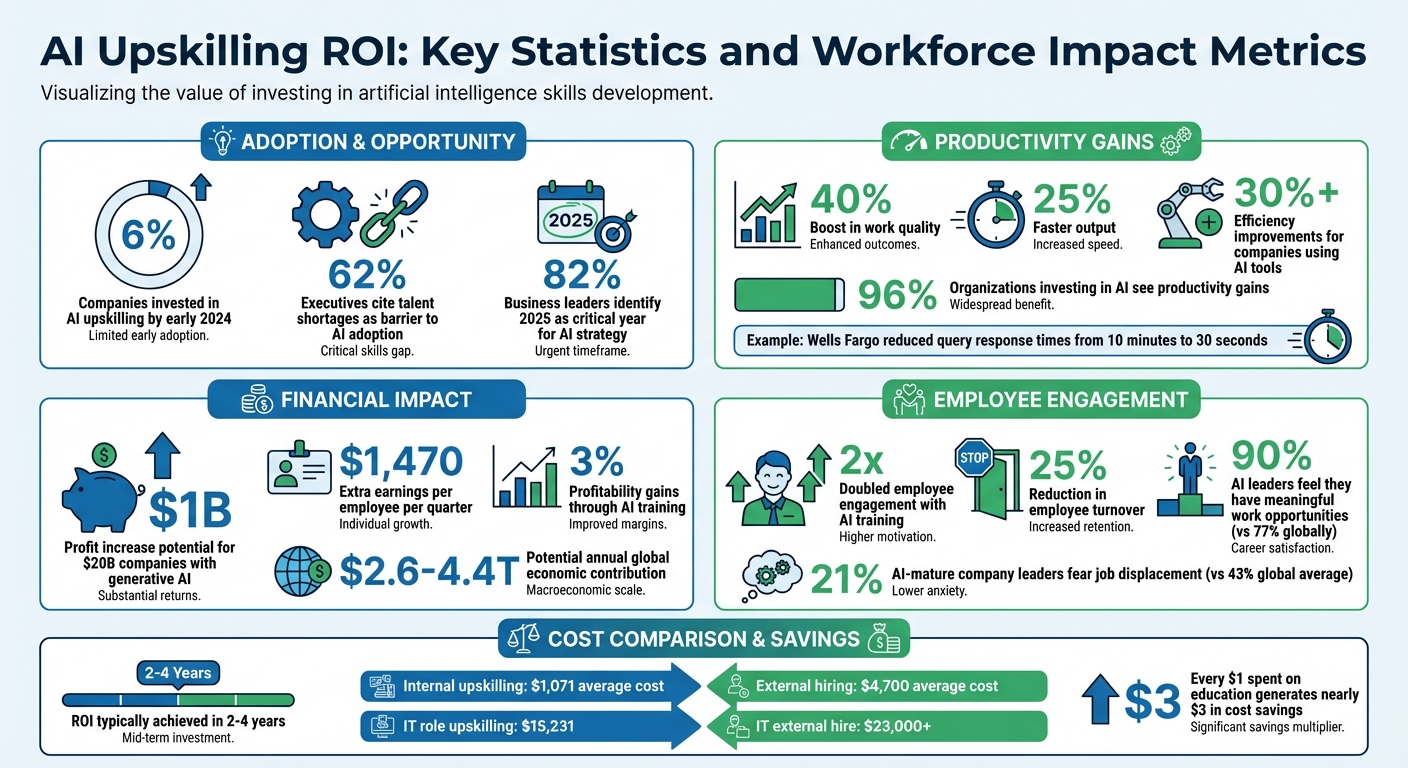
AI upskilling is transforming workplaces by delivering measurable outcomes like increased productivity, cost savings, and higher revenue. Companies implementing AI training report improvements such as a 40% boost in work quality and 25% faster output. For example, businesses generating $20 billion annually can see profits rise by up to $1 billion with generative AI adoption. Despite these benefits, only 6% of companies had invested in AI upskilling by early 2024, highlighting a significant opportunity for growth.
Key takeaways:
- AI Skills Gap: 62% of executives cite talent shortages as a barrier to AI adoption.
- Financial Impact: Trained employees earn an extra $1,470 per quarter, while businesses see 3% profitability gains through AI training.
- Productivity Gains: Companies using AI tools report 30%+ efficiency improvements, with examples like Wells Fargo reducing query response times from 10 minutes to 30 seconds.
- Employee Engagement: AI training doubles engagement and reduces turnover, while fostering confidence in AI's role as a workforce ally.
To measure ROI, businesses should track metrics like productivity, engagement, and financial performance. Using A/B testing and tools like dashboards can help quantify the impact of training. Organizations that prioritize AI upskilling now position themselves for long-term success in a rapidly evolving market.
AI Upskilling ROI: Key Statistics and Workforce Impact Metrics
Smarter Training, Stronger Business: Driving ROI with AI and TalentLMS
sbb-itb-e5dd83f
Key Metrics for Measuring Workforce Impact
When it comes to justifying investments in AI training, the numbers matter. To truly measure the return on investment (ROI) of AI upskilling, businesses need to focus on specific, measurable indicators that tie training efforts directly to outcomes. A well-rounded approach includes tracking productivity improvements, employee engagement, and financial performance.
Productivity Metrics
One way to gauge the success of AI upskilling is by looking at how efficiently tasks are completed. Metrics like issues resolved per hour, query response times, and task automation rates offer concrete insights. For example, in April 2025, Wells Fargo introduced an AI agent to assist 35,000 bankers across 4,000 branches with information retrieval. This initiative led to 75% of searches being handled by the AI, cutting query response times from 10 minutes to just 30 seconds. Similarly, Bayer's Crop Science R&D team implemented AI tools that saved each researcher up to six hours per week on data and innovation tasks.
Another key measure is speed to mastery, which tracks how quickly employees reach full competency after training. Companies actively integrating AI into their operations report productivity boosts of over 30%, compared to a 10-30% improvement for those still in the experimental phase. But it’s not just about speed - quality matters too. Metrics like sales lead conversion rates and customer sentiment scores ensure that increased efficiency doesn’t come at the expense of quality.
Employee Engagement and Retention
AI training doesn’t just enhance skills - it can reshape how employees view their roles and their future with the company. In October 2024, a global retailer with over 500 stores launched an AI-driven upskilling program aimed at improving customer-centricity. By using A/B testing to compare stores with and without the training, the retailer discovered that the program doubled employee engagement and boosted sales by 150 basis points.
The impact of AI training on morale is clear. Among "Frontier Firms" - those leading in AI adoption - 90% of leaders report feeling they have opportunities to do meaningful work, compared to 77% of workers globally. Additionally, leaders in AI-mature companies are less likely to fear job displacement by AI (21%) than the global average (43%). In a 2023 study of 5,179 customer support agents using a generative AI-based assistant, productivity increased by 14%, while customer sentiment and retention also saw improvements.
Cost Savings and Revenue Growth
Once productivity and engagement are quantified, financial metrics complete the picture. AI upskilling delivers financial benefits through operational cost reductions and revenue growth. Companies leveraging the AI ROI Performance Index - a composite measure of financial return, revenue growth, cost savings, and speed of results - gain a clearer understanding of their training investments. On average, training yields a quarterly earnings return of $1,470 and saves leaders more than an hour of work daily. To calculate ROI, businesses should compare gains (like increased revenue and reduced costs) to the total investment, which includes training expenses, vendor fees, technology costs, and productivity losses during training.
Case Studies and Research Insights
Deloitte and EY Findings
The numbers speak for themselves: 96% of organizations investing in AI have seen productivity gains, with 57% describing these improvements as substantial. Despite this, achieving a solid return on investment (ROI) typically takes two to four years, even as 85% of organizations increased their AI spending in 2025. These statistics offer a glimpse into how industry leaders are leveraging AI for long-term success.
Deloitte's research highlights a key insight: the real value of AI emerges when humans and AI work in "convergence", amplifying results rather than merely collaborating. A standout example is Medtronic, which, in October 2025, set an ambitious target to integrate AI into 80% of its HR processes within three years. Rather than simply adding tools, the company focused on rethinking how work is designed.
EY's findings reveal a shift in how companies are channeling AI-driven productivity gains. Surprisingly, only 17% of organizations have used these gains to cut headcount. Instead, most are reinvesting: 47% are enhancing existing AI capabilities, 42% are developing new ones, and 38% are focusing on upskilling and reskilling their workforce.
"Organizations that shift from a productivity mindset to a growth agenda are using AI to drive innovation, create new markets and achieve what was previously considered impossible." – Dan Diasio, EY Global Consulting AI Leader
What sets high-performing "AI ROI Leaders" apart is their emphasis on workforce readiness. For example, 40% of these leaders mandate AI training across their entire workforce. Additionally, companies investing $10 million or more in AI are far more likely to achieve significant productivity gains (71%) than those investing less (52%). These findings underline the importance of upskilling in maximizing AI's potential for productivity and growth.
S&P Global and McKinsey Reports
Adding to these insights, research from S&P Global and McKinsey underscores the massive economic potential of AI-driven upskilling. McKinsey estimates that Generative AI could contribute between $2.6 trillion and $4.4 trillion annually to the global economy, based on 63 specific use cases. In the U.S. alone, effective collaboration between humans and AI could unlock approximately $2.9 trillion in economic value by 2030. Industries heavily exposed to AI have already seen revenue-per-employee grow by 27%, compared to 9% in less AI-intensive sectors.
Real-world examples further illustrate AI's impact. A 2023 study of a company with 5,000 customer service agents found that generative AI improved issue resolution rates by 14% per hour and reduced handling times by 9%. It also cut employee turnover and escalations to managers by 25%. Similarly, software developers using Microsoft's GitHub Copilot completed tasks 56% faster than those working without it. The Mayo Clinic offers another compelling case: since 2016, it has expanded its radiology team by over 50%, while deploying hundreds of AI models to improve image analysis, enhance accuracy, and handle greater volumes of complex cases.
McKinsey identifies four key areas where AI delivers the most value: customer operations, marketing and sales, software engineering, and R&D. Together, these functions account for 75% of AI's annual economic impact. In customer operations alone, AI tools and workforce training can boost productivity by 30% to 45% of current costs.
Local Perspective: NWA AI's Role
In Northwest Arkansas, businesses can tap into these benefits through NWA AI (https://nwaai.org), which offers tailored AI training programs to enhance workforce productivity - even for those without coding experience. Their three-tiered approach, focusing on AI Literacy, AI Leverage, and AI Adoption, equips companies with the skills and tools needed to achieve measurable ROI. By emphasizing practical training and workflow redesign, NWA AI helps local organizations avoid a common pitfall highlighted in Deloitte's research: layering AI onto outdated processes instead of rethinking how work should be done.
How to Calculate AI Upskilling ROI
Step-by-Step ROI Calculation
To calculate ROI for AI upskilling, divide the direct impact (like productivity boosts or revenue growth) by the total costs (training fees, software licenses, etc.).
Start by establishing a baseline. Record metrics such as processing times, error rates, or revenue per transaction before implementing the program. These benchmarks are essential for accurately measuring results. For instance, when Nestlé introduced AI tools in SAP Concur in September 2025, they eliminated manual expense management entirely and tripled employee efficiency in generating reports.
Break your costs into two categories:
- Direct Costs: These include training fees, vendor charges, and platform licenses.
- Indirect Costs: Factor in the time your team spends managing the program and the opportunity cost of employees learning instead of working.
On the impact side, focus on measurable gains like:
- Productivity improvements (time saved in workflows).
- Financial benefits (higher revenue or billable hours).
- Retention savings (lower turnover and reduced hiring expenses).
For example, Booz Allen Hamilton’s data science upskilling program for 1,400 consultants in March 2025 led to an 11% increase in employee retention and a 4% rise in billable hours.
Use A/B testing to measure training effectiveness in critical programs. For instance, a global energy company compared trained frontline leaders with an untrained group, resulting in a 3% profitability boost. If controlled tests aren’t an option, monitor leading indicators like enrollment rates or periodic skills assessments to gauge progress before long-term financial results become evident.
| Cost Category | External Hiring | Internal Upskilling |
|---|---|---|
| Average Cost (General) | $4,700 | $1,071 |
| IT/Technical Role Cost | $23,000+ | $15,231 |
| Time to Productivity | 3–6 months | Immediate to 1 month |
| Hidden Costs | $500/day vacancy cost | Minimal disruption |
(Source: USHireHub, 2025)
Once you’ve collected the data, presenting it clearly and effectively can strengthen your case.
Visualization Tools and Templates
Turn raw data into dashboards that highlight adoption rates, usage trends, and downstream impacts. Instead of focusing on a single year, use multi-year cash flow models to show how AI skills develop and grow over time. For example, SA Power Networks launched an AI-driven app in September 2025, allowing field technicians to access 50 years of asset data. This initiative saved $1 million in a year and achieved a 99% success rate in identifying poles at risk of corrosion - results that became evident after tracking performance over several quarters.
Microsoft also demonstrated the value of visualization when they used AI to tackle forecasting errors. By reducing manual processes by 50% and improving on-time planning by 75%, they showcased their success through before-and-after comparison charts. Highlighting both tangible returns (like time saved or revenue increases) and intangible benefits (such as faster innovation cycles or higher employee satisfaction) can make your reporting even more persuasive.
And here’s a compelling stat to consider: every $1 spent on employee education can generate nearly $3 in cost savings through better retention and fewer hiring needs.
Conclusion and Key Takeaways
The Importance of AI Upskilling
AI upskilling is quickly becoming a cornerstone for sustainable growth and competitiveness. Companies that integrate comprehensive AI training into their operations see impressive results - boosting productivity by over 30%, with some reporting 40% higher quality and 25% faster output.
When employees embrace AI as more than just a tool - as a collaborative partner - it opens the door to greater innovation and smarter decision-making. Conor Grennan, Chief AI Architect at NYU Stern School of Business, puts it perfectly:
"The unlock is when we realize it's not a tool but a new kind of team member"
This perspective enables workers to act as "agent bosses", effectively managing digital tools to expand their capacity and focus on strategic, high-impact tasks. It’s a shift that not only drives creativity but also transforms how teams operate.
With 82% of business leaders identifying 2025 as a critical year to rethink strategies due to AI advancements, and AI literacy becoming the most sought-after skill of that year, companies investing in their workforce today are setting themselves up for long-term success. The gap between organizations fully leveraging AI and those still experimenting is growing fast. These trends highlight the urgency for action.
Taking Action: What Organizations Should Do Next
The time to act is now. Start by defining what you want to achieve with AI - whether it's increasing revenue, cutting costs, improving employee retention, or accelerating innovation. Use tools like the Return on Learning Investment (ROLI) framework to evaluate the impact of your training initiatives. Research shows that companies actively operationalizing AI are 2.5 times more likely to have trained their executive teams on generative AI compared to those still in the testing phase.
For organizations in regions like Northwest Arkansas, NWA AI offers hands-on, customized AI training programs. These workshops are designed to help both individuals and businesses adopt practical AI strategies that deliver real results - no coding expertise needed. The journey to AI success begins with equipping your workforce to effectively use these transformative technologies.
FAQs
How can businesses assess the ROI of AI upskilling programs?
To assess the return on investment (ROI) of AI upskilling, businesses need to begin with well-defined objectives. These might include boosting productivity, cutting costs, or driving revenue growth. Once the goals are clear, it’s essential to establish measurable metrics that align with them - for example, tracking time saved on tasks, reductions in errors, or increases in financial performance.
The next step is to compare these metrics before and after implementing the upskilling program. This comparison helps determine the program's effectiveness and its overall impact on the organization.
By concentrating on measurable results and monitoring progress over time, companies can better understand how AI upskilling enhances workforce efficiency and supports broader business goals.
What challenges make it difficult for organizations to adopt AI despite its clear advantages?
The hurdles in adopting AI often stem more from organizational challenges than technical ones. A common issue is the difficulty senior leaders face in providing clear guidance or swiftly allocating resources to scale AI projects. This delay can slow down progress significantly. On top of that, employees' fears about job displacement can stifle excitement for new AI tools, even when these tools are shown to boost efficiency.
Other roadblocks include the absence of strong executive support, poorly aligned incentives, and a lack of robust training programs. Without these critical components in place, it becomes tough for organizations to translate AI’s potential into tangible outcomes, leaving many companies unable to fully tap into its productivity advantages.
How does AI upskilling improve employee engagement and retention?
AI upskilling boosts employee engagement by giving workers the tools and confidence to integrate AI into their daily tasks. When employees see how their new skills align with the company’s goals, it can create a stronger sense of purpose and connection to the organization, ultimately reducing turnover.
These programs also help ease concerns about job security. By learning to view AI as an opportunity rather than a threat, employees are more likely to embrace the technology and remain with the company. This makes AI training a smart strategy for retention. Plus, when leadership emphasizes AI education, it sparks enthusiasm among employees, leading to higher productivity, stronger engagement, and long-term loyalty.
Build real AI capability on your work
The AI training programs are part of how Northwest Arkansas is approaching AI adoption.
Get involvedRelated Articles
ROI and KPIs in AI Process Optimization
Measure AI impact with ROI and KPIs: set baselines, track hard and soft ROI, and monitor model, system, and business KPIs to validate performance and value.

How Blended Learning Improves AI Upskilling
Blended learning, online modules plus hands-on workshops, boosts AI skill retention, engagement, and real-world application for faster workplace upskilling.

5 Steps to Define AI Workflow Goals
Set measurable AI workflow goals in five steps: map processes, set SMART targets, pinpoint AI opportunities, define KPIs, and align with strategy.