
How AI Upskilling Helps Retain Regional Talent
NWA AI Team
Editor

How AI Upskilling Helps Retain Regional Talent
Northwest Arkansas is facing a talent crisis. Businesses are struggling to fill roles, while many workers lack the skills to advance. With 67% of jobs paying $50,000 or less and over 125,000 workers nearing retirement, the region needs solutions fast. AI upskilling could be the answer.
Key takeaways:
- AI training improves retention: 76% of employees would stay longer if their companies invested in learning and development.
- Bridging the skills gap: Only 33% of employees feel they have access to upskilling, despite 44% of employers claiming to offer it.
- Cost-saving potential: Upskilling saves 70–92% compared to hiring externally.
Governor Sarah Sanders’ recent partnership with Google to offer free AI training is a step forward. Businesses investing in AI upskilling can reduce hiring costs, retain knowledge, and boost productivity. For Northwest Arkansas, this approach is a lifeline to retain talent and stay competitive.
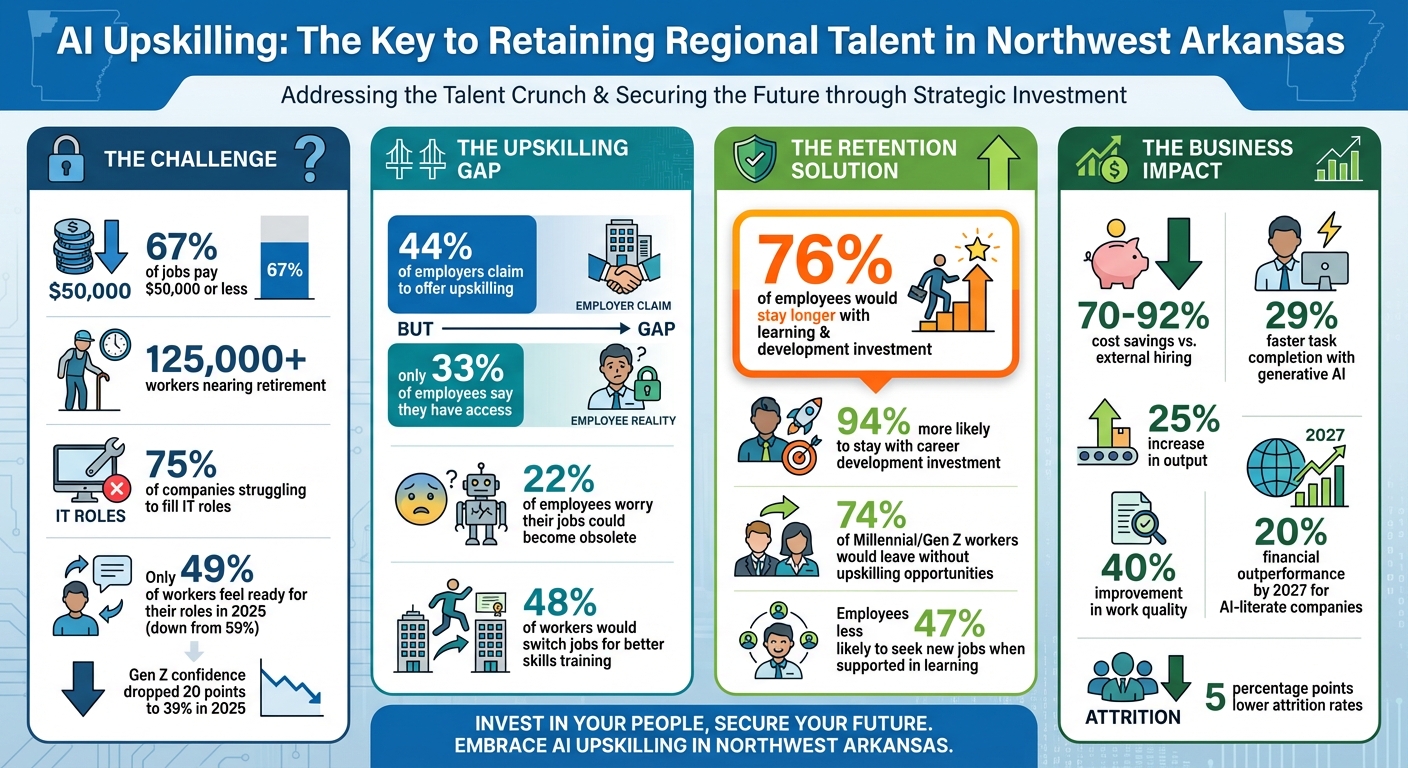
AI Upskilling Impact on Regional Talent Retention: Key Statistics
Why Regional Businesses Struggle to Keep Talent
Competition from Urban Tech Hubs
Urban tech hubs have a magnetic pull on talent, offering higher salaries, cutting-edge technology, and faster career growth. It’s a tough match for regional businesses. In fact, 75% of companies are struggling to fill IT roles in specialized areas like machine learning and generative AI. The allure of urban tech firms, combined with their stronger reputations, often leads to a steady outflow of local talent.
Adding to the challenge, demographic trends are working against regional employers. The number of high school graduates is expected to peak in 2025 and then decline, shrinking the future talent pool. On top of that, increasing retirements are creating additional gaps. These external factors amplify the urgency for regional businesses to address their internal skill shortages.
Skill Gaps and AI Disruption
AI is reshaping workplace demands at a speed that many find overwhelming. By 2030, 68% of workplace skills will be impacted by generative AI, leaving many workers unprepared. This shift has led to a growing confidence gap among employees. For example, only 49% of workers feel ready for their roles in 2025, down from 59% the previous year. The drop is even sharper for Gen Z employees, whose confidence has plummeted by 20 points to just 39% in 2025.
The fear of being left behind is real. About 22% of employees worry that their jobs could become obsolete as AI continues to evolve without adequate training. Unfortunately, there’s a disconnect between employers and employees when it comes to upskilling. While 44% of employers claim they provide upskilling opportunities, only 33% of employees say they have access to them. This gap not only affects individual confidence but also hampers businesses trying to keep pace with technological advancements.
Limited Local Growth Opportunities
Another hurdle for regional businesses is the lack of robust professional development programs. While 92% of employers assert that they offer clear career paths, only 77% of employees agree. This disconnect is particularly noticeable among younger workers. For instance, 65% of recent graduates say they’d stay in a role for four or more years if it included opportunities to develop in-demand skills. Without those opportunities, the number drops to just 32%.
The desire for growth and learning is a major driver for job changes. Nearly half of U.S. workers (48%) say they would switch jobs for better skills training opportunities. Jim Link, Chief Human Resources Officer at SHRM, sums it up well:
"When training isn't timely or contextual, both business progress and employee growth stall".
To combat talent drain, regional businesses need to prioritize targeted AI upskilling and create meaningful development opportunities. Without these efforts, retaining talent will remain an uphill battle.
How AI Upskilling Keeps Regional Talent
Building Employee Engagement and Confidence
AI training programs play a key role in easing the fear that technology might replace jobs. Instead, they show employees that the focus is on preparing them for the future. It's a confidence boost that's much needed - only 47% of employees feel equipped with the skills to excel in their roles. AI upskilling transforms work into an ongoing learning experience. Tools that provide real-time coaching and contextual feedback make this possible, while measurable skill improvements can increase employee motivation by 56%.
Anthony Abbatiello, PwC U.S. Workforce Practice Leader, emphasizes the value of this approach:
"By training talent that is already in-house, businesses promote a greater sense of community, raise morale and engender more loyalty in their workforce."
Aligning Employee Growth with Business Needs
Forward-thinking companies are weaving AI learning into everyday workflows - a concept often referred to as "learning in the flow of work". This ensures training aligns with business goals, allowing employees using generative AI to complete tasks 29% faster. On top of that, 83% of leaders believe AI integration helps employees transition into more strategic and complex roles earlier in their careers. By channeling the efficiencies of AI automation into workforce development, companies prioritizing AI literacy are expected to outperform their peers financially by about 20%.
Using Predictive Analytics to Identify Talent Risks
AI doesn’t just enhance skills; it also helps retain talent by identifying potential risks before they escalate. By analyzing patterns in employee behavior, engagement, and performance, AI can flag early signs of dissatisfaction or disengagement. Employees who feel supported in learning new skills are 47% less likely to actively seek new opportunities. By addressing training gaps - a common reason people leave - AI-driven upskilling turns potential turnover into renewed commitment. This approach not only retains valuable institutional knowledge but also saves the cost and time associated with constant hiring and onboarding cycles.
Benefits of AI Upskilling for Regional Businesses
Reducing Recruitment Costs
Investing in upskilling isn't just a smart move - it’s a cost-effective one. Companies can save 70–92% by upskilling their current workforce instead of hiring externally. For regional businesses, which often compete with urban tech hubs for talent, this savings is even more critical. External hiring comes with hefty expenses, including recruitment fees, screening processes, and lengthy onboarding. By focusing on developing internal talent pipelines, regional companies can significantly cut these costs while improving employee retention. Consider this: 94% of employees are more likely to stay with a company that invests in their career development, and 74% of Millennial and Gen Z workers would leave a job that doesn’t offer upskilling opportunities. In other words, training an employee now could save businesses from the repeated expense of replacing them later.
But the benefits go beyond just saving money. Upskilling also helps preserve the invaluable institutional knowledge that seasoned employees bring to the table.
Preserving Institutional Knowledge
When experienced employees stick around, they carry with them a wealth of company-specific expertise. AI upskilling gives these employees a compelling reason to stay. As Microsoft aptly puts it:
"When your best people stay, capability compounds instead of resetting."
This compounding effect is especially crucial for regional businesses, where finding specialized talent can be more challenging. AI tools can also accelerate the learning curve for junior employees, enabling them to absorb institutional knowledge quickly and take on more strategic roles earlier in their careers. This creates a workforce where expertise grows over time rather than being reset every time someone leaves. Companies that emphasize AI literacy are expected to outperform their peers financially by approximately 20% by 2027. Why? Because they’re able to retain and amplify the knowledge already within their teams. This stable foundation not only boosts operational efficiency but also sparks new ideas and solutions.
Boosting Productivity and Innovation
AI-trained employees don’t just get more done - they do it better. Generative AI has been shown to increase task speed by 29%, output by 25%, and work quality by 40%. With these efficiency gains, employees can shift their focus from routine tasks to higher-value activities like strategic planning and creative problem-solving.
Take CMA CGM, a global shipping and logistics company, as an example. In 2024, they launched an AI skills accelerator where even the CEO, Rodolphe Saadé, participated in training alongside frontline workers. This collaborative approach allowed employees to develop practical AI use cases during training, driving innovation across the company. Similarly, a global retailer with over 500 stores implemented AI upskilling and saw impressive results: a 150 basis point increase in sales per square foot and doubled employee engagement levels. For a company with $20 billion in revenue, such AI adoption could translate into $500 million to $1 billion in additional profits within just 18 months.
These aren’t just isolated examples. Across industries, 83% of leaders believe AI will enable employees to take on more strategic roles earlier in their careers. For regional businesses, this means a clear path to competing more effectively and driving innovation in their markets.
sbb-itb-e5dd83f
How to Upskill Your Workforce for AI in 2025
NWA AI: AI Upskilling Programs for Regional Talent
NWA AI offers targeted training programs designed to connect cutting-edge AI technology with the specific needs of businesses in Northwest Arkansas. These programs focus on equipping the local workforce with the skills needed to thrive in an AI-driven workplace, emphasizing the role of upskilling as a strategy to retain talent.
AI Literacy for Strategic Thinking
At the core of NWA AI's training is AI literacy - a foundational program that helps employees understand what AI can and cannot do, the risks it poses, and the opportunities it creates. This training is tailored to different roles within an organization:
- Executives focus on how AI impacts strategic decisions, investment planning, and governance.
- Technical teams dive into the nuts and bolts of developing and maintaining AI models.
- Frontline workers learn how to use AI tools to make their daily tasks more efficient.
Wyatt Mayham, Founder of Northwest AI Consulting, explains:
"AI upskilling strategy refers to a structured plan for developing workforce capabilities to work effectively with artificial intelligence technologies across an organization."
This role-specific approach highlights how customized training can directly influence talent retention and workforce engagement.
Hands-On Training with AI Tools
The AI Leverage program takes training a step further by focusing on practical, hands-on applications. Employees engage in tasks like sales prospecting, drafting emails, analyzing data, and creating documents. The program helps participants move from basic experimentation with generative AI to mastering agentic AI - advanced systems capable of independently planning and executing complex tasks. This ensures that employees stay ahead of the curve as AI technologies and required skills continue to evolve rapidly.
By focusing on real-world applications, this program supports workforce transformation and demonstrates the tangible benefits of hands-on AI training.
Organizational AI Adoption Strategies
To help businesses fully integrate AI, NWA AI offers an AI Adoption program that embeds AI into everyday operations. This program encourages safe experimentation and rapid learning through initiatives like AI office hours, early-adopter pilot programs, and maturity assessments. These efforts aim to achieve measurable outcomes, such as higher tool adoption rates, increased usage, and productivity improvements.
As Mayham points out:
"The successful organizations of tomorrow will be those that build adaptive learning cultures today - cultures that view continuous skill development as fundamental to operations."
This emphasis on fostering a culture of learning is especially important when considering that while 89% of business leaders recognize the need for better AI skills, only 6% have taken meaningful steps toward workforce upskilling.
Conclusion
Businesses in Northwest Arkansas face a critical decision: invest in upskilling their current workforce or risk losing valuable talent. Research shows that 89% of organizations find upskilling to be a more cost-effective solution than external hiring. Companies that prioritize workforce development also enjoy attrition rates about 5 percentage points lower than those that don’t. With over 125,000 local workers approaching retirement age, the urgency to act is undeniable.
AI-focused upskilling addresses one of the main reasons employees leave: the lack of clear career advancement opportunities. Employees who see defined growth paths are 3.4 times more engaged and 47% less likely to look for other jobs. This not only improves retention but also creates a steady talent pipeline, preserves institutional knowledge, and cuts recruitment costs. These factors highlight why customized upskilling programs are essential for the region’s economic growth.
To meet this need, NWA AI offers tailored, role-specific training programs designed for businesses in Northwest Arkansas. Their initiatives include everything from foundational AI literacy to hands-on training with practical tools, as well as strategies for integrating AI into organizational workflows. These programs help align employee skills with employer demands. As Andy Biladeau from SHRM aptly puts it:
"AI is reshaping every corner of organizations... learning and development can't remain static. It has to evolve as fast or faster than the organizational needs".
The question isn’t whether AI will impact your industry - it’s whether your workforce will be prepared when it does. Companies that treat upskilling as an essential benefit, rather than an optional extra, stand to gain a significant competitive advantage. In fact, 76% of employees say they are more likely to stay with companies that provide continuous learning opportunities. By prioritizing AI upskilling now, businesses in the region can tackle talent shortages and retain their workforce for the long haul.
For Northwest Arkansas companies looking to build a future-ready team and retain top talent, NWA AI offers the tools and training to make it happen. Investing in your workforce today ensures a stronger, more resilient tomorrow.
FAQs
How can AI upskilling help retain local talent in areas like Northwest Arkansas?
AI upskilling empowers employees with the skills they need to stay relevant in a job market that evolves at lightning speed. With technology advancing so quickly, some skills can lose their edge in just a few years. By offering ongoing learning opportunities - like hands-on training with AI tools and practical, real-world applications - businesses can create an environment where growth and innovation thrive. This approach doesn’t just spark creativity; it also keeps employees engaged and invested. When workers see clear opportunities to grow their careers without having to jump ship, loyalty naturally follows.
In Northwest Arkansas, initiatives like the NWA AI Innovation Hub are making AI training more accessible than ever. These programs cover everything from AI literacy to practical use of generative AI tools, even offering strategies for adoption that don’t require any coding experience. Combined with larger workforce development efforts, these programs help local professionals build confidence and grow within the community. The result? A stronger, more stable workforce and reduced turnover in the region.
What challenges do regional businesses face when implementing AI upskilling programs?
Regional businesses face a unique set of hurdles when rolling out AI upskilling programs. One major obstacle is the fast-evolving nature of AI-related skills. Traditional training methods often struggle to keep up, leaving employees with outdated knowledge that doesn’t align with current demands. Without practical, real-world learning opportunities integrated into their daily tasks, employees may feel disconnected or question how these programs will advance their careers.
Another significant challenge is limited resources and expertise. Smaller companies, in particular, often operate with tighter budgets and may not have the in-house knowledge to develop effective AI training initiatives. On top of that, the scarcity of AI-skilled professionals makes it even tougher to bridge these skill gaps efficiently.
Lastly, there’s the issue of employee apprehension. Many workers worry that AI could replace their jobs, which dampens enthusiasm for upskilling efforts. To tackle this, businesses must openly address these fears and show how learning AI skills can not only secure their roles but also open doors to future opportunities.
How does AI upskilling help regional businesses save on recruitment costs?
AI upskilling offers businesses a cost-effective way to address workforce needs by focusing on developing their existing employees' skills rather than hiring externally. By pinpointing skill gaps and delivering targeted training, companies can prepare their current team members to step into new roles. This reduces the reliance on costly recruitment processes, such as job postings, agency fees, and onboarding expenses. Plus, it streamlines hiring timelines and helps avoid the challenges of prolonged vacancies.
For businesses in Northwest Arkansas, the NWA AI – Northwest Arkansas AI Innovation Hub provides practical, no-code AI training programs designed to equip employees with the skills needed to take on more advanced responsibilities. These programs enable companies to transform potential external hires into internal promotions, saving thousands of dollars per hire. At the same time, they help build a stronger local talent pool and lower employee turnover rates.
Build real AI capability on your work
The AI training programs are part of how Northwest Arkansas is approaching AI adoption.
Get involvedRelated Articles

ROI and KPIs in AI Process Optimization
Measure AI impact with ROI and KPIs: set baselines, track hard and soft ROI, and monitor model, system, and business KPIs to validate performance and value.

How Blended Learning Improves AI Upskilling
Blended learning, online modules plus hands-on workshops, boosts AI skill retention, engagement, and real-world application for faster workplace upskilling.

5 Steps to Define AI Workflow Goals
Set measurable AI workflow goals in five steps: map processes, set SMART targets, pinpoint AI opportunities, define KPIs, and align with strategy.