
AI Transformation: Leadership Strategies That Work
NWA AI Team
Editor

AI Transformation: Leadership Strategies That Work
AI transformation isn't just about technology - it’s about leadership. Success depends on aligning teams, building skills, and managing change effectively. Here’s what you need to know:
- Focus on People and Processes: 70% of AI success relies on leadership driving team alignment and process changes.
- Challenges Leaders Face: Gaps in vision, skills, and trust often derail AI initiatives.
- Training and Knowledge: Only 50% of workers using AI receive training. Upskilling non-technical teams is critical for success.
- Scaling AI: Target interconnected operations rather than isolated use cases to see measurable results.
- Tracking ROI: Measure AI’s impact across financial, operational, and workforce metrics.
Leadership is the key to overcoming barriers, scaling AI, and achieving business goals. Organizations that succeed prioritize clear vision, team alignment, and ongoing training.
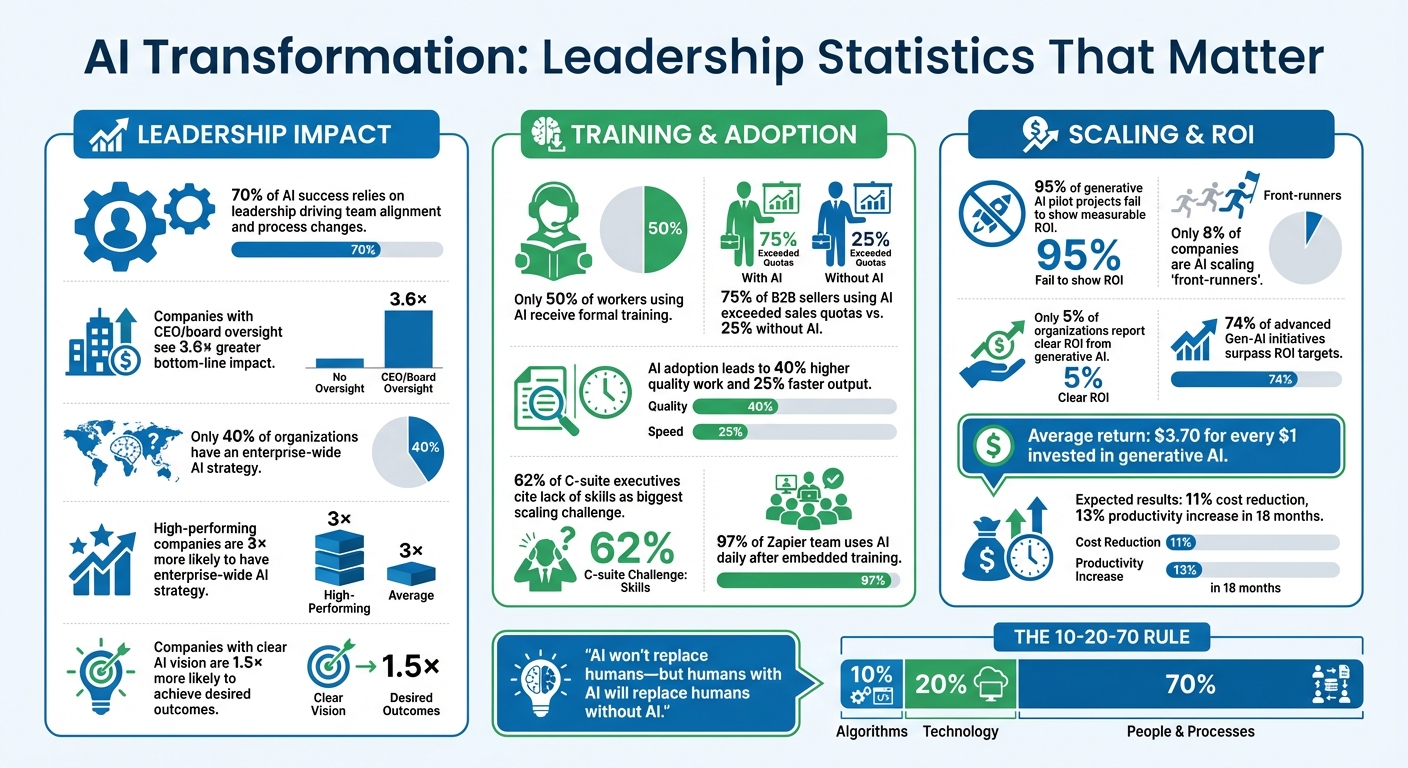
AI Transformation Leadership Statistics and Success Metrics
Setting a Clear AI Vision and Goals
Creating an AI Vision for Your Organization
To make AI work for your organization, it’s crucial to align your AI strategy with your core business objectives. Think of AI as the engine driving your goals forward. For example, if your business prioritizes customer retention, your AI vision should focus on how AI can improve this metric. If market expansion is the goal, your AI roadmap should support that initiative directly.
The most successful organizations take a two-way approach. Business goals shape the AI strategy, but at the same time, emerging AI capabilities can also redefine the organization's direction. Rajeev Ronanki, SVP and Chief Digital Officer at Anthem, explains it well:
When digitally transforming a company, you want greater degrees of efficiency... But there is a second order of business: What new business opportunities, what capabilities does AI open up that allow for servicing adjacent or maybe entirely new areas?
When crafting your AI vision, focus on core operations rather than limiting its scope to support functions. For instance, in the pharmaceutical industry, AI might be leveraged to advance research and development, while in insurance, it could enhance underwriting processes. High-performing organizations set growth-oriented goals - like creating new products, improving customer satisfaction, and entering new markets - rather than focusing solely on cutting costs.
Keep in mind, your AI vision isn’t static. It requires ongoing evaluation and refinement as technology evolves and market conditions shift. Companies with a clearly communicated AI vision are 1.5 times more likely to achieve their desired outcomes. Once your vision is defined and tied to measurable business goals, ensure it’s shared across the organization to drive unified execution.
Aligning Teams Around AI Goals
Having a clear AI vision is one thing; getting your teams aligned around it is another. Effective communication is key to mobilizing everyone. Start by pushing clear AI objectives to business leaders, enabling them to identify local opportunities and challenges. Then, integrate their insights into your broader enterprise strategy.
Companies like Amazon and GitHub provide great examples. Amazon’s top-down directives and GitHub’s "AI for Everyone" initiative show how role-specific communication and cross-department collaboration can drive alignment and meaningful change. Tailor your messaging to different roles: for engineers, highlight how AI can automate repetitive coding tasks, while for others, focus on how it accelerates innovation. Be transparent about job impacts by explaining how roles will evolve and detailing the resources available for skill development.
Interestingly, high-performing companies are more than three times as likely to have an enterprise-wide AI strategy compared to those just beginning their AI journeys. Yet, only 40% of organizations fully agree they have such a strategy in place. This is where leadership plays a critical role. The CEO and C-suite should act as "Communicators-in-Chief", publicly championing the AI vision to inspire internal teams and signal transformation to external stakeholders. This not only attracts top talent but also reassures investors that your organization is ready for the future.
For targeted training that aligns AI adoption with your strategic goals, consider partnering with NWA AI (https://nwaai.org). Their expertise can help ensure your AI journey is both effective and aligned with your business objectives.
Training Teams and Building AI Knowledge
Why Non-Technical Teams Need AI Knowledge
Once your teams are aligned with AI goals, the next step is making sure everyone has the skills to engage with AI effectively. Surprisingly, only about 50% of workers using AI report receiving formal training from their organizations. Yet, the numbers make it clear: understanding AI can lead to better outcomes. For instance, a study of B2B sellers found that 75% of those leveraging AI exceeded their sales quotas, compared to just 25% of their non-AI-using peers.
Non-technical employees play a critical role in AI adoption. When your finance team can see how AI automates variance analysis or your support staff understands how AI can summarize customer tickets, they go from passive observers to active participants. As Russell Goodenough, Head of AI at CGI UK & Australia, puts it:
AI literacy means familiarity and it means being comfortable and confident using day-to-day tools that are empowered with AI. And I think the only way that you can achieve that is by putting the AI in the hands of the users.
The benefits are clear: adopting AI can lead to 40% higher quality work and 25% faster output. However, a major hurdle remains - 62% of C-suite executives cite a lack of skills and talent as their biggest challenge in scaling AI. While employees don’t need to become experts in prompt engineering, they do need to develop two key abilities: context curation (feeding AI the right information) and intent framing (asking purposeful, clear questions). These skills are what transform AI from a shiny tool into a productivity powerhouse.
Training also helps mitigate risks. Without proper guidance, employees may turn to unsecured AI platforms or share sensitive data without safeguards. Structured training not only minimizes these risks but also ensures that AI adoption is cohesive and aligned with organizational goals. The 10-20-70 rule is a useful guideline: dedicate 10% of your AI efforts to algorithms, 20% to technology, and 70% to people and processes. Non-technical teams are a significant part of that 70%.
By building this foundational knowledge, organizations create a solid base for practical, hands-on AI training programs.
Hands-On Training Programs That Work
AI training isn’t about abstract concepts - it’s about real-world application. The most effective programs follow a three-tier approach:
- Foundational training introduces AI basics and company policies to all employees.
- Role-specific training focuses on practical applications tailored to each department (e.g., sales teams learning to draft emails or marketing teams summarizing campaign results).
- Advanced training equips power users and IT staff to design and manage AI workflows at scale.
Zapier offers a great example of how this works in practice. After embedding AI training into their hiring and onboarding processes, 97% of their team now uses AI daily. They’ve even created a "#fun-ai" Slack channel for ongoing learning and host "AI all-hands" meetings where employees share their latest AI-driven solutions. Jessica Lau, Senior Content Specialist at Zapier, sums it up well:
Training turns abstract concepts into actionable habits - so AI becomes part of daily workflows, not an occasional experiment.
Workday took a slightly different route with their "EverydayAI" program, which upskilled nearly 20,000 employees by using People Analytics to foster an "AI-first" culture. Chief People Officer Ashley Goldsmith highlights the value of peer-driven learning:
When a leader invites team members to demo their own AI use cases, it generates more ideas and enthusiasm for others to begin applying AI in their own work.
Google’s "Google AI Essentials" program is another success story. With a $130 million investment, the initiative offers no-code, self-paced courses aimed at non-technical workers. In a pilot program involving Oklahoma state government and Miami-Dade County schools, 74% of participants felt confident applying AI in their roles after just two hours of training. Similarly, 83% of educators in AI literacy programs anticipated saving 2+ hours weekly by using AI for administrative tasks.
For businesses in Northwest Arkansas, NWA AI (https://nwaai.org) provides targeted, hands-on training for non-technical staff. Their AI Leverage program emphasizes practical tools and workflow creation without requiring coding expertise. This approach focuses on real-world application, supported by local mentorship, to quickly move teams from basic awareness to active problem-solving. Programs like these are essential for achieving the full-scale AI transformation envisioned by leadership.
Managing Change and Addressing Resistance
Communicating AI Benefits to Your Team
Training alone won’t guarantee your team embraces AI - especially if they don’t see how it fits into their work. Here’s the reality: only 16% of employees recognize a clear use case for AI, and 15% are concerned about legal or privacy risks. These concerns aren’t baseless; they highlight the need for leaders to communicate more effectively.
The key is to shift the focus from technical jargon to real-world outcomes. Instead of emphasizing features, explain how AI can deliver specific benefits for each department. Dr. Dorottya Sallai from the London School of Economics sums it up well:
AI adoption is a cultural transition.
Part of this transition involves creating a unifying vision. McKinsey refers to it as a "North Star" narrative - a clear explanation of how AI can enhance talent management and streamline daily workflows.
Leaders also need to lead by example. When McKinsey introduced its internal AI platform, "Lilli", in July 2023, executives started asking in meetings, "Have you asked Lilli?" By 2025, 92% of McKinsey’s global workforce had tried the platform, with 74% using it regularly. On average, employees saved over 30% of their time on tasks like synthesizing information. This kind of leadership support makes a difference - employees with managers who encourage AI adoption are 8.8 times more likely to feel that AI helps them perform at their best.
To make the case for AI, provide role-specific examples. For instance, show how AI can automate variance analysis for finance teams or summarize customer support tickets for service teams. Right now, 44% of non-users believe AI doesn’t apply to their tasks. Pairing business leaders with technical experts in a "two-in-the-box" model can bridge the gap, tying business value ("why") to technical feasibility ("how").
Transparency is crucial for building trust. Take Morgan Stanley, for example. They delayed their firmwide AI rollout until June 2024 to ensure their "AI @ Morgan Stanley Assistant" was rigorously trained on 100,000+ proprietary research reports. This commitment to accuracy and clear communication about data security resulted in a 98% adoption rate among their wealth management teams.
By focusing on clear, tailored communication, organizations can lay the groundwork for continuous feedback that refines AI adoption further.
Using Feedback to Improve AI Adoption
Once the benefits of AI have been communicated clearly, maintaining an open feedback loop becomes essential. Continuous feedback is what turns skeptics into advocates. The numbers back this up: organizations that involve at least 7% of their workforce in transformation efforts are twice as likely to see positive outcomes. Yet many leaders skip this step, assuming they already know what employees need.
The first step is to involve end-users early in the process. Before deciding on use cases or building tools, consult the people who will actually use them. As Nufar Gaspar, Director of AI Everywhere at Intel, explains:
If the end-user is not involved in the process and educated/empowered/assured to utilize AI for their best interest - implementation will likely fail.
This early involvement not only reduces resistance but also surfaces practical ideas that leaders might overlook.
Create feedback channels like "superuser groups" or AI clubs to encourage collaboration. McKinsey’s "Lilli Clubs", for instance, allowed enthusiastic early adopters to share tips and recommend improvements. Employees used this framework to build nearly 17,000 custom AI agents, redesigning workflows to meet their specific needs. By involving employees in development, you shift them from passive users to active contributors.
Tailor feedback efforts to different segments of your workforce. About 41% of employees fall into skeptical categories - dubbed "Gloomers" or "Doomers" - and require a different approach than AI optimists. Use surveys or interviews to pinpoint concerns, whether it’s about safety, accuracy, or relevance, and address them directly. The "Situation-Impact-Solution" framework can help focus feedback on actionable improvements.
Finally, tie feedback to measurable results. Only 5% of organizations report seeing a clear return on investment from generative AI, often because they prioritize easy wins instead of tackling meaningful problems. Use employee input to identify projects with the potential to solve pressing challenges and deliver real value. As Jenny von Podewils, Co-CEO of Leapsome, puts it:
Feedback isn’t about instructing or scolding: it’s about giving someone the information and tools they need to develop their strengths and get over their hurdles.
Expanding AI Projects and Tracking Results
How to Scale AI Across Your Organization
Once you’ve achieved initial success with AI, the challenge becomes scaling it across your organization. Surprisingly, 95% of generative AI pilot projects fail to show measurable ROI. Why? Many companies focus on scaling individual use cases instead of rethinking entire business functions.
A domain-focused strategy tends to work best. Instead of rolling out AI tools one by one, aim to transform interconnected operations, like supply chain management or customer service, where results can be seen within 18 months. A great example of this is Wells Fargo. In 2025, they deployed an AI agent to assist 35,000 bankers across 4,000 branches. The results? Query response times dropped from 10 minutes to just 30 seconds, and 75% of searches were handled by the AI agent.
The 10-20-70 rule offers a practical framework for scaling AI: dedicate 10% of your effort to algorithms, 20% to technology and data infrastructure, and 70% to transforming people and business processes. Dow, a materials science company, adopted this approach by implementing AI-driven supply chain agents that identified hidden inefficiencies. This initiative is projected to save millions in its first year by improving billing and logistics accuracy.
To ensure smooth scaling, establish a unified digital foundation. This includes shared prompt libraries, secure cloud storage, and standardized data repositories. These elements prevent departments from building incompatible systems, allowing for a more cohesive transformation. Leadership plays a critical role here, aligning technical frameworks with a broader strategic vision. It's worth noting that only 8% of companies are considered "front-runners" in enterprise-wide AI scaling, having extended just 34% of their strategic efforts. Focusing on domains with shared data and skills ensures that each project builds on prior successes, rather than starting from scratch.
Most organizations follow a predictable evolution in their AI journey: starting with a centralized Center of Excellence, then shifting to a federated model with embedded support, and finally moving to a decentralized approach where departments take full ownership. Companies that successfully scale AI expect to reduce costs by 11% and increase productivity by 13% within 18 months.
Once scalable projects are in place, the focus shifts to measuring their impact effectively.
Tracking ROI and Business Results
Scaling AI is just the beginning. To keep the momentum going, it’s essential to measure its impact thoroughly. This means looking beyond simple cost savings. Experts recommend tracking five key areas: Financial, Operating, Functional, Trust, and Workforce metrics. As Bharat N. Anand and Andy Wu from Harvard Business Review explain:
"The benchmark shouldn't be perfection; it should be relative efficiency compared with your current ways of working."
Start by assessing time savings. For instance, Bayer’s Crop Science R&D team introduced AI agents that helped researchers save up to six hours per week. But don’t stop at time saved - track how that time is redirected into more valuable work that drives outcomes.
Financial metrics are critical, too. Companies leading in AI adoption report 50% higher revenue growth and 60% higher total shareholder returns. High-performing organizations often see 45% more in cost reductions. Operational improvements are equally compelling - whether it’s cutting marketing content cycles from six-to-ten months to just one or two months, or increasing risk management efficiency by 50%.
On the workforce side, consider metrics like "agents per billion of revenue" to gauge AI integration. Trust metrics are also vital. These include monitoring model accuracy, latency, and "deception rates" - instances where AI provides misleading information. With 80% of enterprise data being unstructured, organizing documents, emails, and meeting transcripts is crucial to maintaining AI accuracy.
The numbers tell a sobering story: while 65% of companies use generative AI regularly, only 4% are achieving meaningful business value. Companies that focus on a single strategic priority are nearly three times more likely to exceed ROI expectations. Measurement discipline is non-negotiable - track the metrics that matter, adjust strategies based on results, and take note that 9 out of 10 executives plan to increase AI budgets this year due to promising early metrics.
For more insights and resources on scaling AI and measuring its impact, check out NWA AI - Northwest Arkansas AI Innovation Hub at https://nwaai.org.
sbb-itb-e5dd83f
Building an Innovation Culture and AI Governance
Creating Space for AI Experimentation
Experimenting with AI isn’t just about getting the right tools - it’s about creating an environment where people feel confident to explore. Start by setting up tiered usage guidelines: label fully vetted enterprise tools as "Tier 1", safe for handling sensitive data, and restrict untested public tools to "Tier 2", for non-sensitive tasks. This structure removes uncertainty and gives employees the freedom to experiment without unnecessary risks.
Focus your early trials on areas with minimal downside - think tasks like resume screening or summarizing meetings, where mistakes are less critical. To keep things organized, appoint a Directly Responsible Individual (DRI) to lead your AI initiatives and address any challenges that come up. You can also build a network of volunteer "AI Advocates" to act as mentors, helping to connect big-picture strategies with everyday team workflows. Encourage collaboration by creating Communities of Practice, such as dedicated Slack channels like #how-do-i-ai, where employees can share tips and troubleshoot together.
Matt Nigh, Program Manager Director of AI for Everyone at GitHub, puts it perfectly:
The difference between success and failure isn't buying licenses. It's building the human infrastructure that turns skeptical employees into power users.
By fostering this kind of supportive environment, you lay the groundwork for effective AI governance and ethical practices.
Establishing Robust AI Governance and Ethical Guidelines
While experimentation fuels progress, governance ensures it stays on track. Begin by evaluating your AI projects against responsible AI principles like privacy, reliability, fairness, inclusiveness, transparency, and accountability. Develop clear policies that cover everything from choosing models and using third-party tools to managing data sensitivity and staying compliant with regulations. This is crucial, especially since 80% of business leaders cite challenges like explainability, ethics, bias, or trust as barriers to adopting generative AI.
Introduce a multi-layered oversight system. Start with informal, values-driven checks, and expand to formal processes like risk assessments, ethical reviews, and independent audits. Where feasible, automate monitoring to flag policy violations, bias, or model drift in real time, but always pair automation with human oversight for complex ethical decisions. Under the EU AI Act, non-compliance could result in fines of up to €35 million or 7% of global annual turnover.
Clearly define responsibilities within your leadership team. The CEO should set the tone for AI culture, Legal should manage risks, and Audit teams should ensure data integrity. Build a "golden dataset" to standardize AI model testing and use sandbox environments to trial new models before full deployment. Finally, maintain a "healthy paranoia" by treating AI outputs as fallible and requiring human review for critical decisions.
For businesses in Northwest Arkansas looking to enhance AI skills and adopt ethical practices, NWA AI - Northwest Arkansas AI Innovation Hub offers training programs tailored to teams at all skill levels. Visit https://nwaai.org to learn more about their hands-on AI training and ethical adoption strategies.
Leading AI-Powered Transformation
Conclusion
The success of AI transformation rests heavily on leadership. Organizations that excel in this space tend to follow a proven blueprint: they align their strategic vision with clear business goals, invest deeply in their workforce, manage change with openness, scale thoughtfully while tracking returns, and foster a culture that balances experimentation with strong governance. It’s not just about adopting technology - it’s about addressing the human and procedural challenges that come with it.
The role of leadership cannot be overstated. While 74% of advanced Gen-AI initiatives surpass ROI targets, a striking 42% of firms abandoned projects in 2025, underscoring the critical role leadership plays in bridging this gap. Companies where the CEO or board takes an active role in overseeing AI efforts experience a 3.6× greater bottom-line impact.
"AI won't replace humans - but humans with AI will replace humans without AI."
- Karim Lakhani, Professor, Harvard Business School
For organizations that embrace generative AI, the potential rewards are substantial, with an average return of $3.70 for every $1 invested. However, success requires more than just tools - it demands guidance and structure. For those ready to lead their AI journey with a focus on training and governance, NWA AI - Northwest Arkansas AI Innovation Hub offers hands-on programs tailored to AI literacy, tool application, and organizational adoption strategies. Visit https://nwaai.org to discover how their expertise can help transform experimentation into measurable outcomes.
These statistics highlight a growing divide between AI leaders and those falling behind. The real question isn't whether to embrace AI, but how quickly you’ll act to stay ahead.
FAQs
How can leaders align their teams with AI initiatives effectively?
To get teams on board with AI initiatives, leaders need to start with a clear vision that connects AI goals directly to the organization’s broader objectives. Define what the initiative is meant to accomplish - whether it’s speeding up decision-making, enhancing customer experiences, or driving revenue growth. Be specific with measurable targets, like cutting order processing time by 20% or adding $5 million in revenue. Senior leaders play a critical role here by actively supporting these efforts, allocating the necessary resources, and setting clear milestones to track progress and keep the momentum going.
Collaboration across teams is another cornerstone of success. Pairing tech experts with business leaders ensures that AI solutions are designed to solve practical challenges. Bringing data owners into the conversation early also helps smooth the process. To keep everyone aligned, use tools like visual dashboards, regular updates, and open communication to show how individual contributions tie into the bigger AI picture. Celebrating early successes and rewarding teams for hitting milestones can boost morale and accountability.
Lastly, investing in workforce skills is crucial for sustaining progress. Offering AI literacy programs, hands-on workshops, and training tailored to specific roles helps employees view AI as a tool that improves their work rather than a threat. For example, organizations in Northwest Arkansas can tap into resources like NWA AI, which provides practical training and certifications. These programs are designed to empower teams to use AI in their day-to-day roles - no coding experience required.
How can leaders help non-technical teams effectively learn and use AI?
Upskilling non-technical teams in AI begins with pinpointing the specific AI skills that align with each role and tying training efforts to clear business objectives. Leaders should focus on providing hands-on, practical learning experiences that highlight how AI can be applied in everyday tasks. For example, employees could learn to use AI tools to draft reports, automate repetitive tasks, or analyze customer data. This ensures the training feels relevant and immediately beneficial.
To keep employees motivated, consider offering incentives like public recognition, small bonuses, or opportunities for career growth. Support from senior leadership - such as CEOs or VPs actively promoting AI literacy - can also emphasize its importance. Creating a supportive learning culture is equally critical. Peer groups, internal mentors, or designated AI advocates can help employees gain confidence and develop their skills in a collaborative environment.
For companies in Northwest Arkansas, the NWA AI – Northwest Arkansas AI Innovation Hub offers tailored programs to help non-technical teams embrace AI. Their courses and workshops focus on AI literacy and no-code tools, making the adoption process straightforward - even for those without programming experience.
How can organizations evaluate the ROI of their AI initiatives?
To assess the return on investment (ROI) of AI projects, it's essential to tie each initiative to clear business objectives. These could include goals like cutting costs, boosting efficiency, or enhancing customer experiences. Once these goals are set, track their impact by comparing financial and performance metrics - such as cost reductions, new revenue streams, time saved, or improvements in key performance indicators (KPIs) - against benchmarks established before implementation.
Calculating ROI involves looking at the net benefits - like dollars saved or earned - relative to the initial investment. This method helps businesses see whether their AI efforts are generating measurable value. It also ensures that AI adoption contributes to tangible results and supports the organization’s long-term growth.
Build real AI capability on your work
The AI training programs are part of how Northwest Arkansas is approaching AI adoption.
Get involvedRelated Articles

ROI and KPIs in AI Process Optimization
Measure AI impact with ROI and KPIs: set baselines, track hard and soft ROI, and monitor model, system, and business KPIs to validate performance and value.

How Blended Learning Improves AI Upskilling
Blended learning, online modules plus hands-on workshops, boosts AI skill retention, engagement, and real-world application for faster workplace upskilling.

5 Steps to Define AI Workflow Goals
Set measurable AI workflow goals in five steps: map processes, set SMART targets, pinpoint AI opportunities, define KPIs, and align with strategy.