
AI Skill Trends by Industry: 2025 Guide
NWA AI Team
Editor
AI Skill Trends by Industry: 2025 Guide
AI skills are now essential for professional growth and business success in 2025. Here's what you need to know:
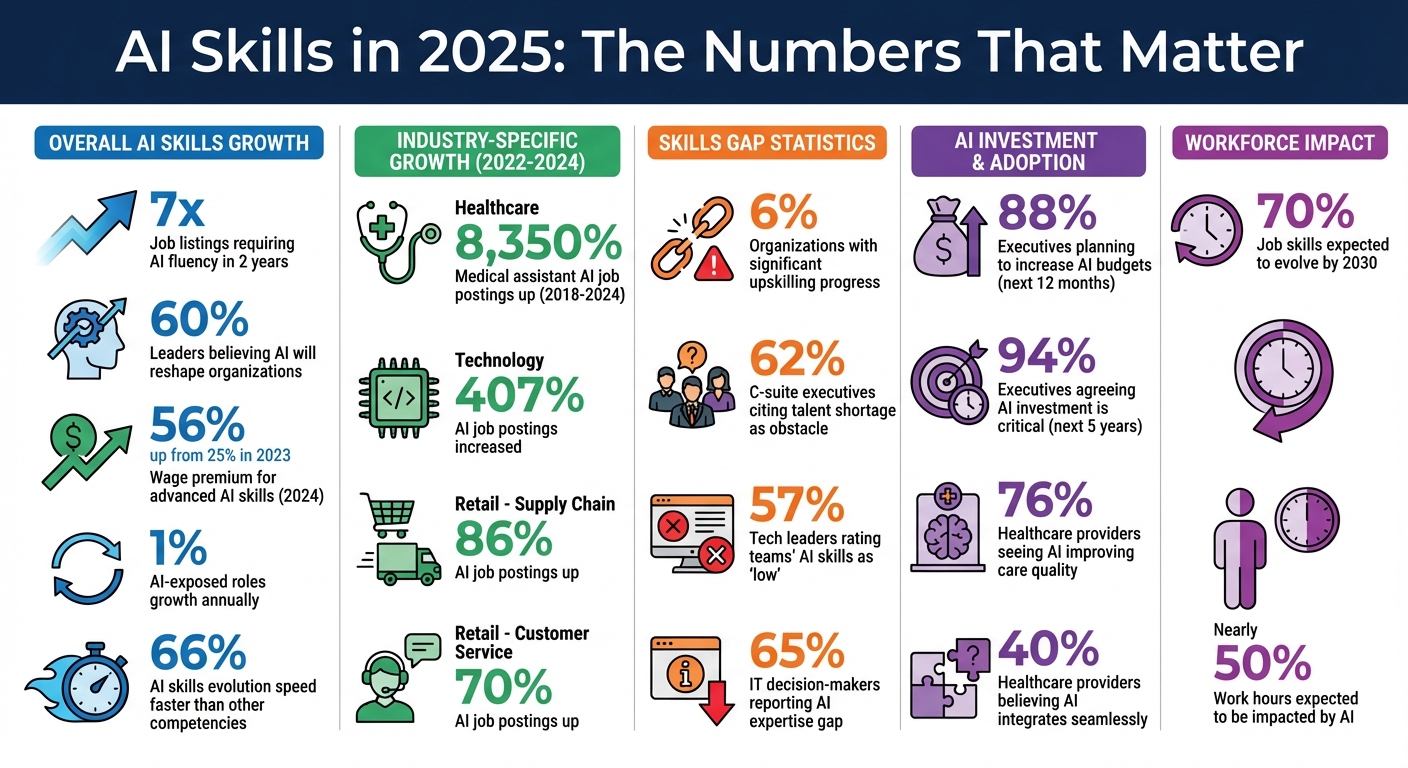
- Demand is skyrocketing: Job listings requiring AI fluency have grown 7x in two years, while 60% of leaders believe AI will reshape their organizations.
- Wage premiums: Workers with advanced AI skills earned 56% more in 2024, up from 25% the previous year.
- Talent gap: AI-exposed roles are growing slowly (1% annually), yet AI-related skills are evolving 66% faster than other competencies.
- Industry focus: Healthcare, tech, retail, manufacturing, and finance are leading in AI adoption, with unique skill needs in each sector.
- Key skills: Human-AI collaboration, AI governance, and multimodal AI systems are critical across industries.
- Upskilling is urgent: Companies investing in AI training are attracting top talent and gaining a competitive edge.
Takeaway: AI skills are no longer optional. Whether you're an individual or an organization, prioritizing AI literacy and hands-on training is the key to staying competitive.
AI Skills Impact: Key Statistics for 2025 by Industry and Growth Metrics
AI Skills by Industry
Healthcare and Life Sciences
AI is reshaping the way healthcare operates. Between 2018 and 2024, job postings for medical assistants mentioning AI skyrocketed by 8,350%. To thrive in this evolving landscape, professionals need a mix of skills, including AI literacy, the ability to interpret clinical data, and a clear understanding of AI model limitations to maintain patient safety. While 76% of healthcare providers see AI as a tool to improve care quality, only 40% believe current AI tools integrate seamlessly into their workflows.
One of the most exciting advancements is in multimodal AI - systems that combine text, images, and data to revolutionize areas like radiology, pathology, and diagnostics. Healthcare organizations are also leveraging AI for administrative tasks, such as medical coding and documentation, freeing up clinical staff to concentrate on patient care. As noted by 3B Healthcare:
"Upskilling for AI must become a continuous journey, ensuring professionals adapt to evolving technologies and ethical considerations".
Technology and Software Development
The tech sector has experienced a 407% increase in AI-related job postings between December 2022 and December 2024. Despite this growth, 57% of tech leaders rate their teams' AI skills as "low", and 65% of IT decision-makers report a gap in AI expertise. The industry urgently needs professionals skilled in Python, machine learning frameworks like TensorFlow and PyTorch, and MLOps to manage AI model lifecycles.
Emerging roles also demand expertise in prompt engineering, a skill critical for guiding AI outputs effectively. Tools like GitHub Copilot have improved coding efficiency by up to 55%, but developers are increasingly shifting from "doing the work" to "directing the work." This involves overseeing AI outputs, addressing edge cases, and ensuring quality control. However, the demand for hands-on AI experience often outpaces what academic programs can currently deliver.
Retail and E-Commerce
AI is transforming retail by optimizing supply chains and automating customer service. Professionals in this sector need skills in data analysis for demand forecasting and building personalization engines to meet growing consumer expectations. Between 2022 and 2024, AI-related job postings in supply chain roles increased by 86%, while customer service roles grew by 70%.
Retail is also advancing beyond basic chatbots, adopting multi-agent systems capable of handling complex, multi-step customer interactions autonomously. As technology evolves rapidly, continuous skill development is essential for staying competitive in this industry.
Manufacturing and Automotive
The manufacturing and automotive sectors are embracing embodied AI, combining digital intelligence with physical capabilities. Workers now collaborate with advanced robotic systems, requiring training in areas like sensorimotor control, workflow redesign, and agent orchestration. Companies that reimagine their processes to integrate human, AI, and robotic collaboration are positioned to gain a competitive edge.
Financial Services
In financial services, AI is becoming indispensable for tasks like risk modeling and fraud detection, with deep learning skills taking center stage. The shift from manual reconciliation to AI-driven analysis highlights the importance of robust AI governance, including ethical oversight and bias control. With 94% of executives agreeing that AI investment will be critical to business success over the next five years, building internal AI capabilities has become a strategic priority.
These trends highlight the growing need for targeted AI skill development across all industries, as organizations adapt to rapid technological advancements and new challenges.
sbb-itb-e5dd83f
Cross-Industry AI Skills
Human-AI Collaboration
The workplace of tomorrow is leaning heavily on partnerships between humans and AI. In fact, the demand for AI fluency - essentially the ability to effectively use and manage AI tools - has skyrocketed, growing sevenfold in just two years. This shift means professionals across industries must focus on developing skills that complement AI rather than compete with it.
This evolution is already reshaping how work gets done. Employees are now tasked with framing critical questions, interpreting AI-generated outputs, and ensuring quality control. As McKinsey's 2025 report highlights:
"Work in the future will be a partnership between people, agents, and robots - all powered by AI."
Take the Mayo Clinic as an example. Since 2016, they've expanded their radiology team by more than 50% while simultaneously deploying hundreds of AI models. AI now handles much of the image analysis, allowing doctors to focus on complex decision-making and patient care. The result? Greater efficiency and improved accuracy.
To make these collaborations effective, strong governance and ethical standards are becoming increasingly important.
AI Governance and Ethics
As AI becomes embedded in everyday business operations, ensuring proper governance and ethical oversight is critical. Companies face challenges such as AI hallucinations, transparency issues, explainability concerns, and bias mitigation. Addressing these is vital for safe and unbiased AI integration. The numbers tell the story: 88% of executives plan to increase their AI budgets in the next 12 months, spurred by the rise of agentic AI. With AI expected to impact nearly half of all work hours, organizations are tying AI adoption to mandatory upskilling and bias testing.
Professionals must also sharpen their ability to spot and address biases in training data. Effective governance involves setting clear protocols, such as requiring human oversight for high-stakes decisions, and maintaining transparent records of AI tools, data sources, and testing plans. These steps help businesses align with frameworks like those from NIST.
Multimodal AI Systems
AI is now capable of integrating text, audio, images, and video into what are known as multimodal systems. This capability is revolutionizing how organizations handle tasks that involve diverse types of data. For instance, models like Gemma 3, Phi-4 Multimodal, and Llama 3.2 are streamlining workflows for everything from infrastructure analysis to customer service.
A real-world example is the New Jersey state government’s "NJ AI Assistant", launched in 2025. This secure generative AI chat tool reduced the time needed for template revisions from weeks to just one hour - at a cost of approximately $1 per user per month. The result? Millions saved for the state.
As multimodal AI becomes more common, even professionals in non-technical roles like marketing, HR, and sales can benefit from foundational knowledge of deep learning. Skills such as designing neural networks for image recognition or natural language processing are becoming increasingly relevant. Additionally, managing complex tasks often requires orchestrating multiple AI agents into cohesive workflows. This ability to unify different AI systems is quickly becoming a key skill in navigating the AI-driven workplace.
How to Build AI Skills
AI Literacy and Basic Training
Building a solid foundation in AI starts with basic understanding. Currently, only 6% of organizations have made significant progress in upskilling their workforce, while 62% of C-suite executives identify talent shortages as the main obstacle to scaling AI initiatives. To overcome this, AI literacy must extend across all roles, including frontline workers. Training programs should cover the basics, such as how AI models operate, their limitations, and how to detect potential biases in their outputs. These programs should also be tailored to specific roles - for instance, customer-facing teams might benefit from an introduction to AI concepts, administrative staff could focus on workflow automation, and leadership teams require strategic-level training.
Take the example of Google and MIT RAISE. Between 2024 and 2025, they launched a 2-hour self-paced course titled "Generative AI for Educators" in areas like Oklahoma and Miami-Dade County. Following the program, 74% of participants reported feeling confident in applying AI to their work, and 83% anticipated saving at least two hours per week. Similarly, organizations in Northwest Arkansas can benefit from NWA AI's AI Literacy program, which offers foundational training designed to help teams understand AI's capabilities, limitations, and potential applications - without requiring any prior coding knowledge. This kind of knowledge lays the groundwork for more advanced, hands-on experience.
Hands-On Training with AI Tools
To truly master AI, hands-on experience is key. The demand for "AI fluency" - the ability to effectively use and manage AI tools - has skyrocketed, growing sevenfold in just two years. A critical skill in this area is prompt engineering, which involves crafting precise prompts to improve the accuracy and relevance of AI-generated outputs. Practical training can include tasks like cleaning data, automating routine emails, and creating chatbots, all of which help reinforce AI proficiency.
IBM provides a great example with its "IBMer watsonx Challenge" (2023–2025). This competition-based learning initiative encouraged employees to apply AI tools to real-world scenarios. The results were impressive: a 100% increase in watsonx digital credential acquisitions and noticeable efficiency improvements in documentation and automation. Similarly, NWA AI's AI Leverage program emphasizes hands-on training to build both confidence and competence in using AI tools for everyday tasks. Once these practical skills are in place, the next step is weaving AI into an organization’s daily operations.
Building an AI Adoption Plan
While individual skill-building is crucial, lasting success requires a well-structured AI adoption plan. One effective approach is the "4E Stage" model - Engage, Explore, Experience, and Embed - which begins with small pilot projects to deliver quick wins and build momentum.
For example, Cisco Systems implemented its "AI Infrastructure Learning Journey", enrolling 272,000 participants by late 2025. Similarly, CMA CGM's CEO spearheaded an AI skills accelerator in 2024–2025 to promote collaboration across the company.
A comprehensive adoption plan should also address governance and ethics. This includes mandatory training on recognizing bias, safeguarding data privacy, and ensuring human oversight in AI applications. To measure the success of these initiatives, organizations can use evaluation frameworks like the Kirkpatrick method, which assesses factors such as participant reaction, skill development, productivity improvements, and overall business outcomes. For organizations ready to scale beyond pilot projects, NWA AI's AI Adoption program offers targeted support to overcome resistance, measure ROI, and drive innovation.
Conclusion
Key Takeaways
As we move toward 2025, AI skills are no longer optional - they're a necessity. With AI fluency projected to grow seven times over and 70% of job skills expected to evolve by 2030, organizations that invest in upskilling today will position themselves ahead of the curve. But here's the catch: technical know-how isn't enough. While AI takes over routine tasks, it's human abilities like strategic thinking, negotiation, and communication that remain essential and least likely to be automated.
The message is clear: the time to act is now.
Next Steps
Action can't wait. The gap between AI-ready organizations and those falling behind is growing fast. Surveys show a sharp increase in AI tool adoption and wage premiums for advanced skills, underscoring the urgency to prioritize upskilling. Simply put, waiting is not a plan.
For those in Northwest Arkansas, NWA AI - Northwest Arkansas AI Innovation Hub offers tailored programs to help you get started. Whether you're aiming to build foundational AI literacy, gain hands-on experience with tools, or craft a strategic adoption plan for your organization, these programs are accessible - even for those without any coding background. The workforce transformation is already happening. The real question is: how soon can you begin?
These AI Skills will give You Immediate Work Advantage
FAQs
What are the most in-demand AI skills across industries in 2025?
By 2025, certain AI-related skills will be in high demand across industries in the United States. One standout is prompt engineering, which focuses on designing precise queries to optimize AI model outputs. This expertise is not only in demand but also commands higher wages. Similarly, AI literacy - understanding how AI operates and addressing its ethical considerations - is becoming essential for integrating AI seamlessly into everyday workflows. Another growing area is proficiency with large language models (LLMs), which includes creating and deploying AI-powered applications, particularly valuable in technical roles.
Additionally, skills like generative AI content creation - using AI tools to produce text, images, or even code - are becoming more relevant. There's also a rising need for AI-augmented analytics, where AI automates data processing tasks and enhances decision-making. These capabilities are transforming traditional fields like finance and healthcare, while also making waves in unexpected areas such as agriculture and construction, where AI is sparking new advancements.
For professionals aiming to stay ahead, NWA AI – Northwest Arkansas AI Innovation Hub provides tailored programs designed to build these skills. These programs are accessible even to those without advanced coding experience, making AI upskilling more approachable for a broader audience.
What’s the best way for professionals to develop AI skills and stay competitive?
To keep pace in the ever-changing world of AI, professionals need to treat upskilling as an ongoing journey. Skills like prompt engineering and large-language-model proficiency are becoming increasingly sought after. Workers in roles impacted by AI are experiencing quicker skill evolution and, often, higher earning potential. Rather than replacing jobs, AI is expected to complement and enhance them, making it crucial to learn how to collaborate effectively with these tools.
A comprehensive approach to building AI skills includes:
- Understanding the basics: Dive into key concepts, ethical considerations, and real-world AI applications through short, beginner-friendly courses.
- Getting hands-on practice: Develop practical expertise in areas like machine learning, data analysis, and natural language processing through project-based learning opportunities.
- Staying connected: Engage with professional networks, join webinars, and commit to ongoing education to stay ahead of AI trends.
For those in Northwest Arkansas, NWA AI – Northwest Arkansas AI Innovation Hub provides tailored programs to meet local needs. These include AI literacy workshops, no-code training sessions, and strategies for incorporating AI into daily workflows. These resources are designed to help individuals and organizations thrive in industries shaped by AI advancements.
What challenges do organizations face when adopting AI in their operations?
Adopting AI into everyday business operations can be a complex journey. Many companies find it difficult to move past experimental pilot projects and scale AI effectively across their organization. To make AI tools truly impactful, businesses often need to overhaul existing workflows. This process can expose inefficiencies and require significant efforts in change management.
Another hurdle is the AI skills gap. The demand for skilled AI professionals has surged far beyond the available talent pool, making it tough to staff projects with the right expertise. Organizations that don’t invest in building AI knowledge across their teams risk falling behind competitors. Even for those that succeed, challenges like navigating regulatory requirements, managing data governance, and ensuring compliance remain critical during implementation.
Build real AI capability on your work
The AI training programs are part of how Northwest Arkansas is approaching AI adoption.
Get involvedRelated Articles

ROI and KPIs in AI Process Optimization
Measure AI impact with ROI and KPIs: set baselines, track hard and soft ROI, and monitor model, system, and business KPIs to validate performance and value.

How Blended Learning Improves AI Upskilling
Blended learning, online modules plus hands-on workshops, boosts AI skill retention, engagement, and real-world application for faster workplace upskilling.

5 Steps to Define AI Workflow Goals
Set measurable AI workflow goals in five steps: map processes, set SMART targets, pinpoint AI opportunities, define KPIs, and align with strategy.