
AI Leadership vs. Traditional Leadership
NWA AI Team
Editor

AI Leadership vs. Traditional Leadership
In today's world, leadership is changing. AI is reshaping how decisions are made, teams are managed, and businesses grow. Leaders now rely on data and AI tools to predict trends, solve problems, and drive efficiency, while traditional leadership focuses on experience, intuition, and hierarchy. Here's a quick breakdown:
- AI Leadership: Uses real-time data, predictive analytics, and automation for faster, data-backed decisions. AI tools act as partners in strategy and operations.
- Traditional Leadership: Relies on intuition, experience, and static processes. Technology is often seen as an add-on rather than a core part of decision-making.
Key Differences:
- Decision-Making: AI leaders use simulations and analytics, while traditional leaders depend on past experience and gut instincts.
- Team Management: AI provides real-time insights into team performance, enabling proactive support. Traditional methods rely on periodic reviews and manual oversight.
- Learning: AI leaders prioritize continuous skill-building and experimentation. Traditional leaders often rely on fixed expertise.
- Ethics: AI leadership embeds ethics into processes from the start, ensuring transparency and accountability. Traditional approaches address issues reactively.
Quick Comparison:
| Aspect | AI Leadership | Traditional Leadership |
|---|---|---|
| Decision-Making | Data-driven, predictive analytics | Intuition, experience-based |
| Team Management | Real-time insights, AI-assisted | Manual oversight, periodic reviews |
| Learning | Continuous skill development | Fixed expertise |
| Ethics | Proactive governance, transparency | Reactive, compliance-focused |
AI leadership combines technology with human judgment, creating opportunities for smarter, faster, and more informed decisions. Leaders who adapt to these changes will thrive, while others risk falling behind.
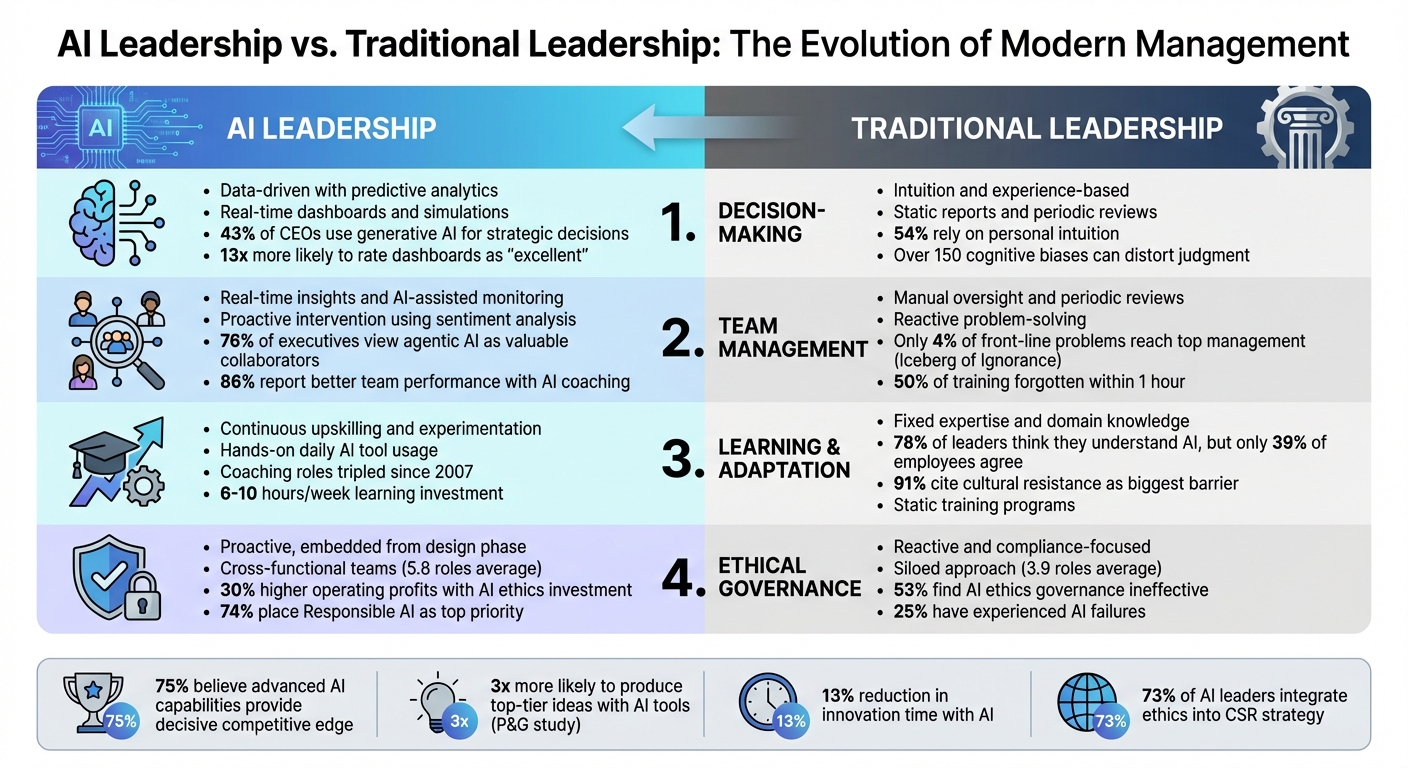
AI Leadership vs Traditional Leadership: Key Differences in Decision-Making, Team Management, Learning, and Ethics
The Future of Leadership: Why AI-Enabled Leaders Will Replace Traditional Leaders
Decision-Making: Data-Driven Insights vs. Intuition and Experience
The way leaders make decisions is undergoing a massive shift. Instead of relying solely on static reports or gut feelings, many are now turning to real-time data and predictive analytics. This shift is a key element in developing an AI-savvy leadership approach.
AI Leadership: Using Predictive Analytics
AI-driven leaders approach decision-making differently. Rather than focusing on past performance with questions like, "What happened last quarter?", they dig deeper, asking, "What factors are driving our growth?" They rely on detailed transactional data to validate their insights. This data-centric approach allows them to simulate thousands of scenarios - such as pricing changes, channel strategies, or promotional campaigns - before committing resources.
For example, a private equity-backed software company used machine learning to analyze 28 million records. This analysis uncovered $1.1 billion in potential cross-sell revenue and flagged $71 million in at-risk annual revenue using 7.7 million predictive scores.
This approach moves away from the outdated "inspection culture", where manual forecasting dominated. Instead, leading CEOs are 13 times more likely to rate their enterprise dashboards as "excellent" for providing actionable insights. Meetings now focus on real-time learning and "what-if" simulations rather than simply reviewing historical data.
Gonzalo Gortázar, CEO of CaixaBank, sums it up well:
"Decision-making based on intuition, common sense, and knowledge is very good and should never be lost. But the more analytic support we have, the better."
The numbers back this up. About 43% of CEOs are already using generative AI to guide strategic decisions, and 75% believe the organization with the most advanced AI capabilities will gain a decisive edge. AI isn't just speeding up decisions - it’s transforming how leaders evaluate risks and opportunities.
Traditional Leadership: Relying on Intuition
Traditional decision-making often leans heavily on experience and static reports. While this approach has its merits, it is increasingly inadequate for tackling today’s complex challenges. One major issue is the influence of cognitive biases - there are over 150 known biases that can distort judgment.
Fernando González, CEO of Cemex, explains this balance:
"The orthodox response is that decisions should be data-driven. In many situations, this works... But in other situations, it is not as clear-cut. I need to know when enough data is enough."
Without a unified, trusted dataset, traditional leaders can waste valuable time debating numbers. Decision-making is further slowed by manual data gathering and periodic reviews. While 54% of CEOs still incorporate personal intuition and experience into their decisions, many are realizing that this alone isn’t enough in today’s fast-paced environment.
That said, intuition still plays a critical role in areas like ethical dilemmas, moral decisions, and managing stakeholder relationships - situations where data may be incomplete or unavailable.
Comparison Table: AI Leadership vs. Traditional Leadership Decision-Making
The table below highlights the key differences between AI-driven and traditional decision-making approaches.
| Challenge | AI Leadership Approach | Traditional Leadership Approach |
|---|---|---|
| Team Performance Decline | Uses predictive scores to anticipate churn and productivity risks | Relies on manual oversight and periodic performance reviews |
| Market Shifts | Runs simulations to test thousands of scenarios quickly | Relies on historical patterns and commercial judgment |
| Complex Decisions | Uses AI as a "devil's advocate" to challenge biases and groupthink | Depends on hierarchical oversight and gut instinct |
| Risk Management | Proactively addresses bias and ensures transparency with real-time dashboards | Reacts based on past experience and static risk assessments |
| Speed of Decision | Accelerated by automated insights and continuous learning cycles | Slowed by manual data compilation and review processes |
For industries like retail, logistics, and food processing in Northwest Arkansas, this shift is particularly relevant. Traditional methods, like relying on gut feelings for inventory management, are being replaced by AI-driven models that adjust assortments in real time. Organizations such as NWA AI (https://nwaai.org) are helping professionals bridge the gap by offering AI literacy programs and practical training to integrate expertise with AI-driven tools.
This evolution in decision-making is creating a new kind of leadership - one that thrives on adaptability and continuous learning.
Learning and Adaptation: Continuous Upskilling vs. Fixed Knowledge
The skills that once guaranteed success may no longer suffice in today’s fast-evolving, AI-driven world. What worked five years ago might now fall short, creating a clear divide between leaders who embrace continuous learning and those who rely on their established expertise.
AI Leadership: Lifelong Learning and Upskilling
Leaders who excel in the AI era know that true proficiency comes from hands-on experience, not just theory. They actively experiment with AI tools in their daily routines rather than waiting for formal training. Take Donna Morris, Chief People Officer at Walmart, as an example. She uses ChatGPT for tasks ranging from executive searches to travel planning. This hands-on approach allows her to quickly identify polished but shallow content - what she calls "workslop" - and focus on high-quality outputs.
The shift in leadership requirements is evident in job postings. Since 2007, roles emphasizing coaching, collaboration, and influence have tripled, while those centered on traditional supervision have steadily declined. At Microsoft, Jean-Philippe Courtois replaced an inspection-heavy culture with a coaching-focused one. By training managers in coaching and introducing real-time dashboards, Microsoft freed up thousands of hours for more meaningful client interactions.
Building diverse networks also plays a key role in staying ahead. Leaders who engage with startups, regulators, and technologists outside their immediate circles gain fresh perspectives on risks and opportunities, enhancing their AI readiness. For instance, organizations like NWA AI in Northwest Arkansas offer practical programs that teach professionals how to integrate AI into workflows without needing to code. This hands-on learning mirrors the kind of engagement necessary at the executive level.
Traditional Leadership: Fixed Expertise
Traditionally, leaders have relied on deep domain expertise to establish their authority. While this worked in stable environments, it struggles in today’s fast-changing landscape. A disconnect is becoming increasingly clear: 78% of leaders believe they understand AI, but only 39% of their employees agree. Similarly, while 42% of CHROs are prioritizing AI investments, only 5% of their HR teams feel prepared to use these technologies.
The challenges go beyond technology. A staggering 91% of data leaders at large companies identify cultural resistance and change management - not technical hurdles - as the biggest barriers to becoming data-driven organizations. Leaders clinging to static expertise risk falling behind because they fail to unlearn outdated practices.
Moving from Fixed to Adaptive Leadership
To thrive in an AI-powered world, leaders must shift from fixed expertise to adaptive leadership. This means embedding learning into daily routines and fostering a culture where teams feel safe to experiment, share failures, and challenge outdated assumptions without fear of repercussions. At SAP, CFO Dominik Asam led a transformation of the finance function by integrating generative AI. Routine tasks were automated, allowing his team to focus on strategic work and acquire new skills for the future.
Leadership success profiles are also evolving. Traits like command, control, and deep technical mastery are being replaced by adaptability, curiosity, and the ability to manage human-machine collaboration. As Bryan Ackermann, Head of AI Strategy & Transformation at Korn Ferry, explains:
"When the transformation gets tough or the path isn't clear, AI-ready leaders are the anchor that holds the vision steady".
Similarly, Karim Lakhani, Professor at Harvard Business School, emphasizes the urgency of adaptation:
"AI won't replace humans - but humans with AI will replace humans without AI".
For leaders navigating the AI transformation, continuous adaptation isn’t just beneficial - it’s essential.
sbb-itb-e5dd83f
Team Management: AI-Augmented Insights vs. Manual Oversight
Managing a team today is about finding the right balance between guidance and empowerment. Traditional methods lean heavily on manual check-ins, rigid processes, and reacting to problems only after they arise. On the other hand, AI-powered leadership provides real-time insights into team dynamics, allowing leaders to step in with tailored solutions before small issues snowball into bigger challenges. This shift highlights the contrast between AI-driven collaboration and the more conventional methods of oversight.
AI Leadership: Transforming Collaboration with Technology
AI is reshaping the way leaders understand and support their teams. Instead of waiting for quarterly reviews or exit interviews to uncover problems, tools like AI sentiment analysis can monitor communication across platforms like Slack, email, and project management tools. This proactive approach helps identify signs of disengagement or conflict early, giving leaders the chance to step in with timely support.
Traditional hierarchies often suffer from what Sidney Yoshida described as the "Iceberg of Ignorance", where only 4% of front-line problems make it to top management, even though employees are aware of all of them. AI bridges this gap by offering leaders a clear, comprehensive view of their teams' realities through data-driven insights.
Take Procter & Gamble, for example. During a field experiment from May to July 2024 involving 791 professionals, teams using an internal GPT-4-powered tool were three times more likely to produce top-tier product development ideas. Additionally, AI reduced the time needed for innovation by 13%. Fabrizio Dell'Acqua, a Postdoctoral Researcher at Harvard Business School, summed it up perfectly:
"If you want to be in that top 10% of performers, a full human team plus AI seems like the recipe for success."
AI also helps tackle coordination issues. Tools like Zoom AI Companion and Fireflies.ai can transcribe meetings and assign tasks automatically, saving teams up to 23 minutes typically lost to switching between tasks. Similarly, at MarqVision, Director of People Yunjung (Rina) Bae introduced Deel AI in September 2025 to instantly address HR, compliance, and policy-related queries. This reduced wait times across time zones and eased the administrative load on the HR team.
Beyond improving productivity, 76% of executives now view agentic AI - systems capable of planning and acting on their own - as valuable collaborators. These AI systems handle routine tasks, freeing leaders to focus on strategic decisions and the interpersonal aspects of their teams.
Traditional Leadership: Challenges of One-Size-Fits-All Methods
While AI allows for tailored and timely interventions, traditional leadership methods often rely on uniform, delayed responses. Annual reviews, standardized training sessions, and manual check-ins are hallmarks of this approach. While these methods can work in predictable environments, they often fall short in addressing the diverse needs of modern teams. Leaders relying solely on these methods may miss early signs of disengagement because they depend on periodic check-ins rather than ongoing feedback.
Another challenge is the inefficiency of traditional training. Studies show that employees forget 50% of what they learn within an hour, 70% within a day, and 90% within a week. This makes one-size-fits-all workshops less effective compared to AI-driven, personalized coaching delivered exactly when needed.
Additionally, manual oversight often leads to delays. Gathering and analyzing scattered data can take 3–5 days, meaning leaders may miss opportunities to act swiftly.
Examples: AI in Conflict Resolution and Team Development
AI doesn't just enhance decision-making and learning; it also plays a pivotal role in resolving conflicts and fostering team growth. AI-powered behavioral assessments, using frameworks like DISC, Enneagram, or CliftonStrengths, can anticipate potential friction points between team members. By suggesting tailored communication strategies, these tools help prevent conflicts before they arise. Research even shows that AI coaching is as effective as human coaching for achieving goals, with a negligible difference of less than 0.01 on standardized scales. Furthermore, 86% of users of AI-driven coaching report better team performance.
At Weber Shandwick North America, CEO Jim O'Leary shared in September 2025 that using AI tools to draft communications in his voice and streamline team workflows saves him one to two hours daily. This extra time allows him to focus on providing personalized support to team members who need it most.
For those in Northwest Arkansas aiming to adopt these capabilities, NWA AI (https://nwaai.org) offers hands-on training to help leaders integrate AI tools into their team management practices.
Ultimately, AI isn't here to replace human judgment in team management - it enhances it. By combining AI's data-driven insights with their own emotional intelligence and strategic thinking, leaders can create environments where teams collaborate more effectively, conflicts are resolved faster, and individual team members receive the support they need to excel.
Ethical Considerations: Active AI Governance vs. Reactive Control
Managing ethics in AI highlights a major divide between traditional and AI-driven approaches. Traditional leadership often treats ethical issues as a reactive measure - something to address only when compliance or regulations demand it. AI leadership, however, takes a different route, embedding ethics into decision-making from the very beginning. This proactive approach isn’t just about avoiding trouble; it’s about creating systems and cultures where trust is woven into the technology itself. This mindset sets the groundwork for how AI leaders treat ethics as a core part of their strategy.
AI Leadership: Tackling Bias and Emphasizing Transparency
AI leaders view ethics as a responsibility that spans the entire lifecycle of AI systems - from initial design to real-world deployment. Instead of waiting for problems to arise, they establish cross-functional teams (including legal, risk, ethics, and operations experts) to evaluate high-impact AI use cases early on. This proactive stance pays off: organizations that invest heavily in AI ethics report 30% higher operating profits linked to AI initiatives compared to those with minimal investment over a two-year period.
Consider Mastercard’s efforts. By 2025, they had formalized "Data and Tech Responsibility Principles" and created an AI Governance Council to oversee ethical considerations. They also collaborated with the Quebec Artificial Intelligence Institute (Mila) to enhance bias testing and mitigation strategies for real-world applications. Similarly, JP Morgan has a dedicated Responsible AI governance team within its model risk division, staffed by over 20 specialists as of April 2025. Their head of AI policy reports directly to the CEO, and the Chief Information Security Officer has publicly outlined responsible AI standards for third-party vendors.
Transparency plays a critical role here. Over half of executives cite transparency and explainability as major barriers to AI adoption. Without these, AI systems often go unused, undermining their potential value. As Kevin Werbach from the Wharton Accountable AI Lab points out:
"If a decision can't be explained, it can't be trusted".
AI leaders prioritize explainable models that non-experts can understand and implement tools to monitor AI systems in real time, ensuring they operate within ethical and trust-based parameters.
The numbers back this up: 74% of AI leaders place Responsible AI at the top of their management agenda, compared to just 46% of non-leaders. These leaders involve an average of 5.8 roles in their AI initiatives, while reactive organizations engage only 3.9. Nitzan Mekel-Bobrov, Chief AI Officer at eBay, highlights the alignment between responsible AI and broader corporate priorities:
"Many of the core ideas behind responsible AI, such as bias prevention, transparency, and fairness, are already aligned with the fundamental principles of corporate social responsibility, so it should already feel natural for an organization to tie in its AI efforts".
Traditional Leadership: A Reactive and Siloed Approach
Traditional leadership, by contrast, often takes a reactive stance on ethics. This approach relies on rigid hierarchies and predefined policies, treating ethics as a "check the box" exercise rather than a strategic priority. When ethical challenges emerge, they are typically addressed through single-function accountability models - often confined to IT or Legal - rather than being tackled as a collective, cross-functional issue. Unsurprisingly, 53% of organizations find their AI ethics governance ineffective, largely because these siloed structures fail to manage AI’s complexity.
This reactive approach carries risks. Nearly 25% of organizations have already experienced AI failures, ranging from technical glitches to outcomes that harm communities. These failures often stem from organizational shortcomings - like inadequate governance structures - rather than purely technical issues.
Traditional leaders tend to focus on risk mitigation and compliance, rather than seeing ethics as a driver of innovation or competitive advantage. Steven Vosloo, Digital Policy Specialist at UNICEF, underscores the challenges this creates:
"It is not enough to expect product managers and software developers to make difficult decisions around the responsible design of AI systems when they are under constant pressure to deliver on corporate metrics. They need a clear message from top management on where the company's priorities lie".
Building Trust Through Ethical Leadership
Ethical leadership in AI doesn’t just prevent failures - it builds trust, a critical asset for any organization. Trust doesn’t happen by chance; it requires deliberate governance and attention. Research shows a clear connection between investing in Responsible AI and improved business performance, with trust serving as the bridge between the two. Organizations that prioritize Responsible AI before scaling their AI initiatives significantly reduce risks, while those that scale first often encounter more failures.
For leaders in Northwest Arkansas eager to adopt ethical AI practices, NWA AI (https://nwaai.org) offers training programs to help organizations integrate responsible AI principles into their workflows. These programs focus on AI literacy and hands-on training, offering practical strategies to ensure transparency and ethical governance.
Shifting from reactive control to active governance requires a deeper alignment between AI efforts and broader Corporate Social Responsibility (CSR) goals. Among organizations that lead in Responsible AI, 73% consider their ethics efforts part of their CSR strategy, compared to just 35% of non-leaders. Vipin Gopal, Chief Data and Analytics Officer at Eli Lilly, captures this sentiment:
"Responsible AI enables responsible innovation. It would be hard to make the argument that a biased and unfair AI algorithm powers better innovation compared with the alternative".
Building trust also involves setting clear ethical boundaries for AI systems. Leaders document "red lines" for acceptable AI use and pair every ethical principle with actionable steps - like impact assessments or embedding ethics ambassadors within teams. This approach ensures that ethics isn’t just a lofty ideal but a practical guide for everyday decisions.
The urgency to act is growing. The rise of "agentic AI" - systems with greater autonomy and complexity - demands a shift from reactive approaches to strategic ethical frameworks. Since it takes an average of three years for businesses to see the benefits of Responsible AI initiatives, leaders need to start building these capabilities now, before challenges arise.
Key Takeaways for Emerging Leaders
Transitioning into AI leadership doesn’t mean throwing out everything that’s worked in the past. It’s about expanding your approach to meet the demands of a tech-driven world. Traditional leadership often relied on hierarchy, static expertise, and reacting to problems as they arose. In contrast, AI leadership involves becoming both a coach and an architect - redesigning workflows to combine human judgment with AI capabilities, rather than simply layering technology onto old processes.
To succeed, build what some call your "second muscle" - a technical fluency that bridges business challenges with AI solutions. You don’t need to dive deep into data science, but investing 6–10 hours a week to stay updated on AI trends, consult with vendors, and experiment with tools can set you apart as a leader. Menno Van der Winden, former Head of Quality and Product Development at Tata Steel, shared this perspective:
"I'm not a data scientist. What I've learned is to identify the attractive problems worth solving".
This shift - from focusing on execution to identifying high-value problems - is a cornerstone of effective AI leadership.
Once you’ve developed this technical fluency, put it into practice daily. Use AI tools regularly in both your work and personal life. Doing so not only sharpens your skills but also signals to your team that it’s okay to experiment and learn. By visibly using AI tools, you create a culture where trying new approaches is encouraged over striving for perfection. This fosters an environment where your team feels safe to innovate.
A key part of this shift involves prioritizing coaching over inspection. As AI takes over routine tasks, your role evolves into empowering your team to focus on higher-value work. For instance, Microsoft’s Jean-Philippe Courtois replaced a traditional "inspection culture" with a "coaching culture" supported by real-time digital dashboards. This change freed up thousands of hours for client engagement. It’s no surprise that 75% of organizations now see coaching and team empowerment as essential leadership behaviors in the AI era.
Finally, ethical governance must be a foundational part of your leadership. Addressing bias, maintaining transparency, and fostering cross-functional oversight aren’t just compliance tasks - they’re vital to building an effective AI strategy. For leaders in Northwest Arkansas, resources like NWA AI (https://nwaai.org) offer programs on AI literacy, hands-on tool development, and ethical AI adoption. These programs can help you transform workflows without needing coding skills. By combining ongoing learning, practical application, and ethical oversight, you’ll develop the mindset needed to lead effectively in the AI age.
FAQs
How does AI leadership enhance decision-making compared to traditional approaches?
AI leadership is reshaping how decisions are made by tapping into data-driven insights rather than relying purely on gut instinct. With tools like predictive models and real-time analytics, leaders can uncover patterns within massive datasets, making decisions faster and with greater precision. This approach minimizes cognitive bias, allows for testing various scenarios, and helps forecast outcomes before committing resources.
Traditional methods often rely on periodic reviews, but AI systems work differently - they process new data continuously. This empowers leaders to track key metrics in real time and adjust strategies on the fly. By automating routine analyses, AI not only saves time but also lets leaders focus on high-level strategic choices. Plus, AI-powered dashboards provide easy-to-understand visuals, making the decision-making process both more efficient and more confident.
For businesses in Northwest Arkansas, NWA AI offers customized training to help leaders seamlessly integrate AI into their workflows. Through AI literacy programs and interactive workshops, NWA AI equips teams with the know-how to adopt these technologies effectively, sparking innovation and driving improved results.
Why is continuous learning crucial for AI leadership?
Continuous learning plays a key role in effective AI leadership because the landscape of AI technologies and their applications is always shifting. Staying informed about the latest tools, ethical challenges, and the impact of AI on job roles is crucial for leaders to make smart decisions and stay relevant in their positions.
Studies highlight that successful AI leaders prioritize reskilling, upskilling, and encouraging critical thinking within their teams. This strategy helps organizations adapt to fast-paced changes, ensuring they can close the gap between their workforce's skills and the demands of AI-driven projects, keeping those projects on course.
To meet this growing need, NWA AI – Northwest Arkansas AI Innovation Hub offers specialized training programs. These include AI literacy courses and hands-on practice with no-code tools, making it easier for leaders to embrace continuous learning. With these resources, they can drive progress and innovation without needing an in-depth technical background.
How do AI leaders address ethical challenges effectively?
AI leaders treat ethics as a cornerstone of their strategy, not an afterthought. They integrate responsible AI (RAI) policies into their governance structures from the start, ensuring these frameworks are firmly in place before launching any AI models. By conducting thorough impact assessments, they identify risks that could affect individuals or communities and align their safeguards with emerging regulations, like the AI laws being developed in states such as New York and California. This forward-thinking approach helps address potential issues before they reach customers.
To uphold ethical standards, these leaders implement ongoing monitoring and emphasize transparency. They establish cross-functional ethics committees, require human oversight for high-stakes decisions, and promote AI literacy throughout their organizations. Training programs - such as those from NWA AI - equip employees with the knowledge to use AI tools responsibly, even without technical expertise. By embedding ethics into every layer of their operations, AI leaders not only tackle challenges head-on but also foster trust in their innovations.
Build real AI capability on your work
The AI training programs are part of how Northwest Arkansas is approaching AI adoption.
Get involvedRelated Articles

ROI and KPIs in AI Process Optimization
Measure AI impact with ROI and KPIs: set baselines, track hard and soft ROI, and monitor model, system, and business KPIs to validate performance and value.

How Blended Learning Improves AI Upskilling
Blended learning, online modules plus hands-on workshops, boosts AI skill retention, engagement, and real-world application for faster workplace upskilling.

5 Steps to Define AI Workflow Goals
Set measurable AI workflow goals in five steps: map processes, set SMART targets, pinpoint AI opportunities, define KPIs, and align with strategy.