
Checklist for AI-Driven Workplace Transformation
NWA AI Team
Editor

Checklist for AI-Driven Workplace Transformation
AI is changing how businesses operate, but treating it like standard software often leads to failure. Success requires rethinking workflows, training employees, and aligning leadership.
Key insights:
- AI adoption stats: 75% of companies use AI, but over 50% of employees feel unprepared.
- Big wins: AI can cut costs by 40% and boost revenue by 60%.
- Steps to success: Assess readiness, secure leadership support, improve data quality, and invest in workforce training.
- Case studies: Fayetteville Health Systems reduced critical healthcare response times by 49.5% using AI tools.
This guide provides actionable steps for building the infrastructure, upskilling teams, and scaling AI initiatives effectively. Ready to reshape your workplace with AI? Start by evaluating where your organization stands today.
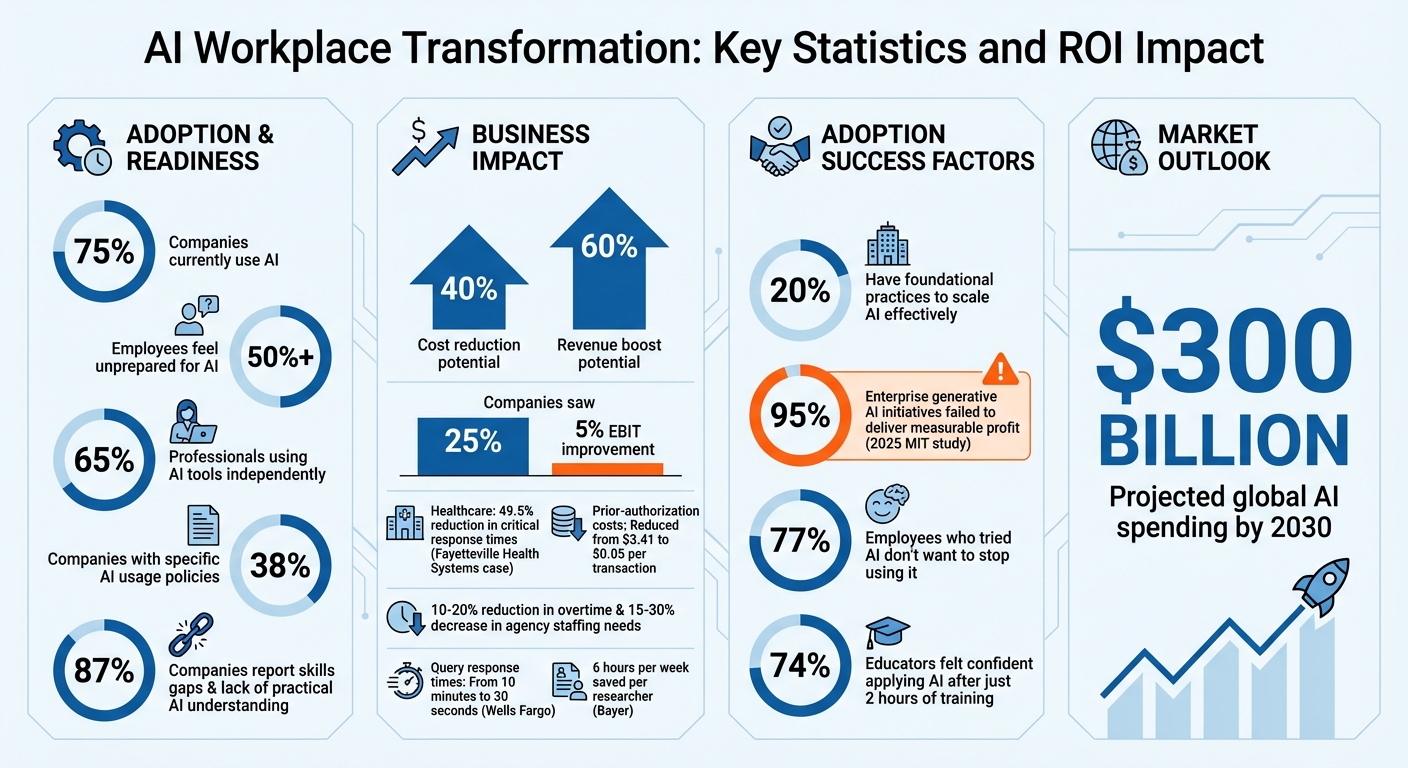
AI Workplace Transformation: Key Statistics and ROI Impact
The definitive guide to AI transformation: Building the Superworker organization
Assessment and Planning Phase
To set the foundation for a successful AI strategy, start by taking a hard look at your current capabilities. Before diving into AI tools or training, it's crucial to understand where your organization stands today. This involves a comprehensive evaluation across strategy, data, technology, governance, and culture. Think of it as taking inventory before making any major investments in AI.
Evaluate Current AI Readiness
Begin by using a maturity model to gauge your organization's readiness for AI. Frameworks like the MITRE AI Maturity Model and Microsoft AI Readiness Assessment can help you evaluate key areas such as Business Strategy, AI Governance, Data Foundations, Organization & Culture, and Infrastructure. These models categorize readiness into stages like Exploring, Planning, Implementing, Scaling, and Realizing. Knowing your stage helps set realistic goals for what AI can achieve in your organization.
Data quality is another critical factor. As Ken Boyer, Director of Product Development at Domo, puts it:
"Inputting poor data into an AI tool is not going to provide you with valuable insights. As the saying goes, 'garbage in, garbage out.'"
. Before diving into AI, ensure your data is accurate, consistent, complete, and properly labeled. Without high-quality data, even the most advanced AI models will produce unreliable results. Also, don't overlook your technical infrastructure. Machine learning demands significant storage and processing power, so assess whether your current data centers and networks can handle these requirements without strain.
Once you’ve assessed your readiness, it’s time to define the metrics that will measure your success and return on investment (ROI).
Define Success Metrics and ROI
Focus on KPIs that tie directly to measurable outcomes, such as dollars saved or time reduced. For example, in healthcare, automating prior-authorization workflows has cut per-transaction costs from $3.41 to just $0.05. Similarly, AI-driven staffing models have led to 10–20% reductions in overtime and 15–30% decreases in the need for agency staffing. These aren’t just theoretical benefits - they represent real savings that directly impact your bottom line.
Align your metrics with your organization's maturity level. For instance, a Level 1 organization might aim for basic efficiency gains using tools like Copilot, while a Level 4 organization could focus on optimizing performance across complex generative AI applications. Also, build in a 20–30% buffer for learning curves and unexpected challenges in your ROI timeline. AI projects rarely go perfectly as planned, and this contingency helps manage expectations.
Secure Leadership Buy-In
Getting leadership on board is essential. Executive buy-in isn’t just about approving budgets - it’s about aligning AI initiatives with your organization’s broader goals and fostering an environment where experimentation is encouraged. Stephanie Woerner, Principal Research Scientist at MIT CISR, emphasizes:
"We recommend bringing a team of senior technical and data leaders together to assess which of the four stages your enterprise is in today."
. Organizations with this kind of top-level leadership involvement often outperform their industry peers financially.
Start with low-risk pilot projects that focus on internal, non-customer-facing processes. These pilots allow you to demonstrate the value of AI without exposing your business to unnecessary risks. Develop a prioritized roadmap that ranks use cases by both their strategic importance and feasibility. Keep in mind that 65% of professionals are already using AI tools on their own. Leadership must step in early to establish governance frameworks that channel this enthusiasm into productive, well-aligned initiatives.
Building Infrastructure and Upskilling Workforce
Once you have leadership backing and clear metrics to measure success, the next step is building the technical backbone and equipping your team with the knowledge to make AI work for your organization. This is where the rubber meets the road - you're no longer just planning; you're actively creating the systems and skills needed to bring your AI strategy to life.
Implement Data Infrastructure and Pilot Projects
Start by evaluating your computing power, storage, and network capabilities to ensure they can handle AI workloads. But it’s not just about hardware. You’ll also need tools for data cleaning, processing, and indexing, especially if you're working with retrieval-augmented generation (RAG) systems. Security is critical here - use multi-factor authentication, encryption, and tiered access to safeguard your data. For instance, Tier 1 tools should be reserved for handling sensitive information, while Tier 2 tools can be used for non-confidential tasks.
Pilot projects are a great way to test the waters. They let you evaluate both the technical feasibility and potential business benefits of AI solutions in a controlled setting. To get started, map out all your data sources, formats, and their quality. This will help you identify what needs to be prepared and which use cases should take priority.
Upskill Employees with AI Literacy Training
Technology alone won’t drive transformation - your team needs to know how to use it effectively. In fact, 87% of companies report gaps in skills and a lack of practical AI understanding. And this training shouldn’t just target technical staff; it needs to empower everyone in the organization with role-specific learning paths.
The most effective training programs follow the "4E" Framework: Engage (create awareness), Explore (offer learning opportunities), Experience (provide hands-on practice), and Embed (integrate AI into daily workflows). A great example of this is IBM’s "IBMer watsonx Challenge", which encouraged employees to solve real business problems using watsonx tools. This initiative doubled the number of digital credentials earned and significantly saved time. Similarly, Google’s "Google AI Essentials" program invested $130 million in a nine-hour course designed for non-technical users, with a focus on improving productivity. In partnership with MIT RAISE, 74% of educators who participated in just two hours of training felt confident applying AI in their classrooms.
Gaby Lio, Vice-President at CGI, sums it up well:
"AI literacy is more than just trainings. It includes hands-on practice, good judgment, and knowing when to trust, challenge or complement AI output".
The focus should be on teaching concepts like "intent framing" (how to craft purposeful AI inputs) and "context curation" (providing the right data for AI to process). To support this, create a centralized resource hub with approved tools, policies, and reusable AI components. Encourage collaboration by establishing communities of practice, such as Slack channels, where employees can share knowledge and solve problems together.
For those in Northwest Arkansas, NWA AI offers hands-on training programs tailored to mastering AI tools and building efficient workflows - no coding required. Their "AI Leverage" program focuses on real-world productivity improvements, while "AI Adoption" helps organizations craft strategies, address resistance, and measure ROI.
With a trained team in place, the next step is managing the organizational changes AI brings.
Integrate Change Management Strategies
Adopting AI isn’t just about implementing new technology - it’s about helping people adjust. Assign a Directly Responsible Individual (DRI) to oversee AI tools, facilitate cross-functional coordination, and track adoption metrics. Build a network of internal champions who can mentor peers and share real-world success stories to encourage adoption. As Russell Goodenough, Head of AI at CGI UK and Australia, puts it:
"Change management is 90% of the job. And that's not changed".
To ease employee concerns, establish clear usage policies with tiered guidelines. This is especially important given that 65% of employees are already using AI independently, often ahead of formal company policies. Yet, only 38% of companies have specific AI usage policies in place. Be transparent about how AI will impact roles, focusing on upskilling efforts rather than vague reassurances. For example, CGI worked with a construction company to drive adoption of Microsoft Copilot 365 by skipping generic training and instead using real project estimates in Excel to demonstrate how AI could streamline workflows.
sbb-itb-e5dd83f
Scaling and Sustaining Transformation
Once your initial AI projects start delivering results, the real challenge begins: scaling those successes across your organization while maintaining momentum. This isn’t just about adding more software licenses - it’s about turning early wins into lasting, meaningful changes.
Expand AI Pilots to Full-Scale Deployment
Scaling AI effectively means looking beyond basic usage metrics. Instead of focusing on Monthly Active Users (MAU), shift your attention to Monthly Engaged Users (MEU) - those who consistently incorporate AI into their workflows rather than just experimenting with it. For example, GitHub's "AI for Everyone" initiative introduced a metric called "AI Leverage", which measured the gap between potential and actual productivity gains. This helped identify where adoption was thriving and where it needed more support.
To drive these scaling efforts, appoint a dedicated leader with experience in AI implementation. This individual acts as an internal consultant, overseeing strategy, managing change, and ensuring smooth integration across departments. A case in point: At Integrato, a consulting team co-led a Microsoft 365 Copilot pilot for a sales department. By collecting baseline data on proposal writing and delivering targeted training, they cut the average proposal time by 40%. This success opened the door for AI adoption in other departments like finance and customer support.
Another effective strategy is creating an "AI Sandbox" - a safe space where employees can experiment with AI tools on low-stakes tasks without fear of failure. Pair this with a "Train the Trainer" model, where volunteer AI Advocates receive upskilling to mentor their peers and lead workshops in their departments. This grassroots approach often spreads knowledge faster and more effectively than top-down initiatives.
These strategies lay the groundwork for embedding AI into your company’s culture, ensuring it becomes a core part of how your organization operates.
Build a Culture of Innovation
Once AI is scaled, the next step is fostering a culture that embraces innovation. This begins with leadership. When senior leaders actively use AI tools and openly share their experiences - including their mistakes - it creates a sense of psychological safety for employees to experiment. At Wells Fargo, for instance, the deployment of an AI agent to 35,000 bankers across 4,000 branches drastically reduced query response times from 10 minutes to just 30 seconds. Today, 75% of searches are conducted through the AI agent.
Encourage collaboration by establishing Communities of Practice through platforms like Slack or Microsoft Teams. These channels can serve as spaces where employees share AI-related tips, troubleshoot issues, and celebrate wins. GitHub’s #how-do-i-ai channel is a great example - it became a hub for peer-to-peer learning, helping to scale AI proficiency across its global workforce.
As Chris Fernandez, Corporate VP of HR at Microsoft, aptly puts it:
"The future of AI will wholly be hinged on how human beings see and interact with the technology… I can think of no other professional more central to the future of AI than HR."
Promote a growth mindset by encouraging employees to share both their successes and failures. This approach reduces fear and builds confidence. In fact, 77% of employees who tried AI reported they didn’t want to stop using it - but they first need the freedom to experiment.
Develop Hybrid Roles and Continuous Learning
As AI becomes more integrated, roles within the workforce need to evolve. The focus should shift from replacing humans to augmenting their capabilities. Let AI handle repetitive tasks so employees can concentrate on creativity and strategic thinking. For example, managers can act as coaches, identifying areas for automation, while senior staff can take on roles as AI mentors, guiding their peers.
AI literacy should become a core part of onboarding, alongside skills like communication and problem-solving. Instead of building internal training programs that quickly become outdated, organizations can curate learning paths using high-quality external resources that keep pace with AI’s rapid advancements. For instance, the NWA AI - Northwest Arkansas AI Innovation Hub offers practical programs like "AI Leverage" for mastering tools and "AI Adoption" for overcoming resistance and measuring ROI.
Consider Bayer’s Crop Science R&D team, where researchers used an AI agent to streamline product development. Each researcher saved an average of six hours per week - time that could then be redirected toward more innovative work. As Matt Nigh, Program Manager Director of AI for Everyone at GitHub, explains:
"Companies fail at AI adoption because they treat it like installing software when it's actually rewiring how people work. The difference between success and failure isn't buying licenses. It's building the human infrastructure."
The ultimate goal is to establish continuous learning loops where employees discover smarter ways to work, share their insights, and inspire others to do the same. This ongoing process ensures that AI remains a powerful tool for growth and innovation.
Monitoring, Metrics, and Continuous Evolution
Scaling AI is just the beginning - keeping it effective requires constant attention. The data your AI systems rely on can shift unexpectedly, leading to performance issues that might not be immediately apparent. That’s why continuous monitoring is critical. Without it, AI can quickly go from being an asset to a liability.
Track Key Performance Indicators (KPIs)
It’s not enough to just track adoption rates; you need to measure outcomes that matter to your business. Gaby Lio, AI Innovation Expert at CGI, explains:
"It's not just adoption, but what are the outcomes from that adoption that we are seeing?"
Focus on metrics tied to real results, like faster project completion, higher productivity, or improved success rates on bids. For example, Microsoft Copilots have shown they can deliver returns in days rather than weeks when compared to custom Azure AI workloads. A 2021 study found that around 25% of companies saw a 5% improvement in EBIT (Earnings Before Interest and Taxes) thanks to AI adoption.
It’s also important to balance the hard numbers with softer metrics. Consider employee sentiment, confidence in using AI tools, and overall well-being. Keep an eye on training completion rates, adoption across departments, and self-reported proficiency levels. Fred Miskawi, Vice-President and AI Innovation Expert Services Lead at CGI, highlights the need for vigilance:
"What I speak a lot with customers about... is building healthy paranoia. When you're leveraging the technology, just assume that it's not going to be 100% and that there's a certain amount of oversight that you need to bring in".
For long-term planning, it’s wise to account for a 20-30% buffer to cover learning curves and unexpected technical challenges. These metrics don’t just track progress - they help you prepare for the next step: managing risks and maintaining ethical AI practices.
Address Risks and Ethical Concerns
AI systems need protection from misuse, bias, and security vulnerabilities. Regular red-teaming exercises, where teams actively try to exploit weaknesses in your AI, can help identify potential issues before they escalate. The NIST AI Risk Management Framework, introduced on January 26, 2023, offers a structured approach to managing these risks.
Transparency is key. Establish processes that allow employees and customers to challenge AI decisions and report concerns. This isn’t just about meeting compliance standards - it’s about building trust. For example, in HR or management settings, ensure there are clear, human-driven mechanisms to review AI recommendations. Employees should also know what data is being collected about them, how it’s being used, and have options to correct inaccuracies or opt out.
Monitor for model drift, which occurs when AI performance declines as real-world data deviates from its training data. Maintain a centralized inventory of your AI systems, complete with documentation, incident response plans, and protocols for human intervention when needed. Use risk categorization tools, like Red-Amber-Green scales, to prioritize resources and address issues ranging from minor to critical. When working with third-party AI vendors, demand proof of rigorous testing and a commitment to responsible practices.
Plan for Long-Term AI Evolution
Once immediate risks are under control, look ahead to how AI can evolve with your business. AI isn’t a one-time project - it’s a capability that needs to grow alongside your strategic goals. While over 75% of companies use AI in at least one function, fewer than 20% have the foundational practices needed to scale it effectively. A 2025 MIT study found that 95% of enterprise generative AI initiatives failed to deliver measurable profit impact due to poor integration and readiness.
To avoid these pitfalls, create a long-term roadmap with clear milestones tied to your strategic KPIs. Use maturity models to regularly assess your progress in areas like strategy, governance, and engineering, so you can address gaps before they become major obstacles. Set up continuous retraining systems to keep your models accurate and secure as data and technology change. Transition from activity-based metrics, like billable hours, to value-driven outcomes, such as higher project margins or rewards for innovation.
Building a strong foundation early is crucial. Invest in cloud-native, API-driven architectures and clean data pipelines before diving into specific AI tools. Incorporate ethical reviews and bias checks from the start to prepare for future regulatory scrutiny. With global AI spending expected to hit $300 billion by 2030 and stricter rules on transparency and fairness on the horizon, companies that establish solid governance now will be better equipped to adapt.
For organizations in Northwest Arkansas aiming to strengthen their AI capabilities, NWA AI offers programs like "AI Adoption" to help measure ROI and address challenges, ensuring AI initiatives succeed rather than becoming costly missteps.
Conclusion and Next Steps
Bringing AI into your workplace isn’t just about getting the latest software - it’s about reshaping how work gets done. The organizations that thrive with AI are the ones that focus on building the skills and mindset needed to turn skeptics into confident AI users.
Key Takeaways
Here’s a quick summary of the steps for a successful AI transformation. Start by defining the outcomes you want, then figure out the data and tools you’ll need to get there. Use a step-by-step approach - envision, align, launch, scale - instead of trying to overhaul everything at once. It’s worth noting that while 88% of organizations already use AI in some capacity, only those with advanced AI maturity consistently outperform their competitors.
Don’t overlook the human factor in this transformation. Assign a Directly Responsible Individual (DRI) to lead your efforts, establish an AI Advocates program, and create Communities of Practice to share knowledge and skills. When it comes to tools, implement a two-tier policy: Tier 1 for vetted enterprise tools that can handle sensitive data, and Tier 2 for public tools restricted to non-sensitive tasks. Most importantly, invest in upskilling your team. Frameworks like EPOCH - Empathy, Problem-solving, Observation, Creativity, and High-level strategy - can help your workforce develop the skills that AI can’t replicate.
How NWA AI Can Support Your Journey
If you’re ready to take the next step, local resources can make a big difference. For organizations in Northwest Arkansas, NWA AI offers three tailored programs to help you succeed:
- AI Literacy: Equip your team with a clear understanding of AI’s strengths, weaknesses, and strategic potential.
- AI Leverage: Provide hands-on training with tools that improve workflows and boost productivity.
- AI Adoption: Build strategies to overcome resistance, establish governance, and measure ROI for long-term success.
These programs address the gap between the 65% of organizations using AI independently and the 38% with formal policies in place. By focusing on skill-building and governance, NWA AI helps you avoid costly mistakes and accelerate your AI journey.
FAQs
How can we determine if our organization is ready to adopt AI?
To determine how prepared your organization is for adopting AI, start by examining how your current business objectives, data resources, and workforce capabilities line up with AI opportunities. Pay close attention to areas like business strategy, data quality, technology infrastructure, governance, and employee skills. Ask yourself questions such as: Are your AI goals tied to clear, measurable outcomes? Is your data secure and easy to access? Is leadership committed to promoting AI understanding and providing opportunities for skill development?
After spotting any gaps, focus on addressing the most pressing issues first. For instance, make sure your data is well-managed, your technology infrastructure can handle AI tools, and your team has access to relevant training. If you notice a skills gap, programs like NWA AI can be a great option. They provide hands-on training, helping employees confidently use AI tools without needing coding experience. Keep revisiting your readiness assessment regularly to monitor progress and make adjustments as your AI initiatives grow.
What are the key steps for successfully integrating AI into the workplace?
To bring AI into your workplace effectively, start by setting clear business objectives. Are you aiming to cut costs, boost efficiency, or spark new ideas? Once you’ve nailed down your goals, identify specific AI use cases that align with them. Having accurate, relevant, and up-to-date data is critical for these efforts, so develop a solid data strategy to ensure your AI initiatives stay on track.
Start small with pilot projects to show the value AI can bring before diving into larger implementations. You might also consider building an in-house AI team to integrate AI solutions directly into your workflows. But remember, technology is only one piece of the puzzle - your people are just as crucial. Invest in company-wide AI training to help employees use AI tools effectively, even if they don’t have technical backgrounds. Programs like those from NWA AI can equip teams with practical, non-technical AI skills.
Adopting AI isn’t just about tools; it’s a shift in how your organization operates. Encourage open communication, identify internal AI champions to lead the charge, and keep a close eye on performance. Regular feedback is key - use it to refine both your AI models and your processes to ensure they stay aligned with your business goals over the long term.
How can we evaluate the ROI and overall success of our AI projects?
To evaluate the return on investment (ROI) of your AI projects, start by establishing clear financial goals and measurable outcomes. Focus on tracking cost savings (like reduced labor hours or fewer errors) and revenue growth (such as faster time-to-market or the creation of new revenue streams), expressed in dollar amounts. A straightforward ROI formula - (benefit - cost) ÷ cost - can help you calculate concrete financial returns. Complement this with metrics like productivity improvements (e.g., tasks completed per hour) and efficiency gains (e.g., shorter cycle times).
However, financial results aren’t the only measure of success. Broader indicators, such as data quality, model accuracy, adoption rates, and workforce upskilling (like tracking training hours completed), can provide a fuller picture of how AI impacts your organization. Aligning KPIs with business objectives and using dashboards to track progress will help you present meaningful insights to stakeholders.
For businesses in Northwest Arkansas, NWA AI offers training programs designed to help teams define KPIs, collect actionable data, and create monitoring tools - no advanced coding skills needed. By combining financial ROI with operational and strategic metrics, you can develop a well-rounded understanding of your AI initiative’s true value.
Build real AI capability on your work
The AI training programs are part of how Northwest Arkansas is approaching AI adoption.
Get involvedRelated Articles

ROI and KPIs in AI Process Optimization
Measure AI impact with ROI and KPIs: set baselines, track hard and soft ROI, and monitor model, system, and business KPIs to validate performance and value.

How Blended Learning Improves AI Upskilling
Blended learning, online modules plus hands-on workshops, boosts AI skill retention, engagement, and real-world application for faster workplace upskilling.

5 Steps to Define AI Workflow Goals
Set measurable AI workflow goals in five steps: map processes, set SMART targets, pinpoint AI opportunities, define KPIs, and align with strategy.